As we age into our more mature years, many of us find our kids “parenting” us on the little things: telling us what to do about a checking account, giving us advice on how to dress for the weather or sharing the latest on what we should be eating for breakfast. Some of it’s helpful, even delightful; some of it isn’t.
Cathie Gandel wrote that for years she sent her sons off with the same blessing: “Take care of your little selves. You are precious and irreplaceable, and I love you very much.
At the end of a recent visit with Matt, her 50-year-old son, she felt a subtle shift in their relationship. “After a final hug at the airport, Matt whispered to me, ‘Take care of your little self. You are precious and irreplaceable, and I love you very much.’ ”
“Our roles may have changed,” she wrote, “but the blessing endures.”
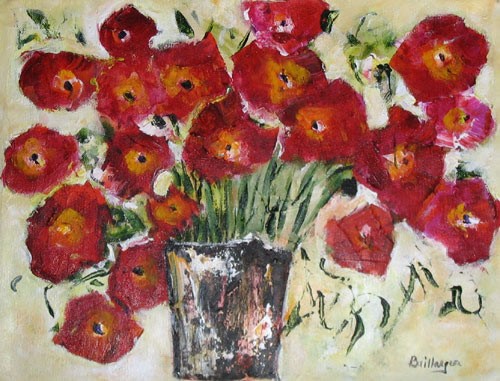
Painting: Carole Baillargeon, “Au Couleur de la vie”
PARENTING GROWN CHILDREN: The children may be grown but we still have our issues.
I must have been prescient when I wrote my previous post about people who didn’t want to be with family on Thanksgiving. That wasn’t me, of course. I was looking forward to traveling to my son’s house and being with my son, daughter, their spouses and my grandchildren. Grandpups, too. I was in fine fettle when I spun out a “what if” scenario of not being able to join them. Turns out, the day after I posted , I got sick–not seriously ill, just queasy and congested enough to make dealing with airports and flights intolerable. So I was by myself for the Big Day (Slept through most of it; the upside of being sick.) and the Big Meal (A big loss since my DIL is a terrific cook; I had soup, which was about all I could tolerate).
I bring this up now because that previous post seems to have tapped into a larger trend. A good number of people want to free themselves from being with family on Thanksgiving. The message they’re sending out: Going back to the family home (often the parental manse) means exposing themselves to dysfunctional family dynamics, being treated like a younger version of themselves or feeling unaccepted. They’re not only raising the issue, they’re writing, podcasting or otherwise broadcasting their feelings about it.
A case in point is this Washington Post video by Jeff Guenther, aka “Therapy Jeff.” Guenther recalls the bad vibes from previous family Thanksgivings and the relief he’s found in no longer attending the holiday get-togethers. Here are some excerpts:
“Every time I’d fly home for the holiday I’d get these awful headaches and feel insanely anxious as I tried to shapeshift myself into the version of myself that I thought my family needed in order to love me.”
Ten years ago he stayed home and surrounded himself with friends and “it was honestly the most liberating decision I have ever made.”
“A lot of people think you have two options. Either go home and suffer or you stay home and feel guilty. There’s actually a middle path. You can go home strategically and protectively.”
“Use gray rocking. Be pleasant, be polite, be boring. Don’t hand them any tender information they can twist into a concern or judgment. Not everyone deserves access to the inner world. Some people only get the surface and that is more than enough.”
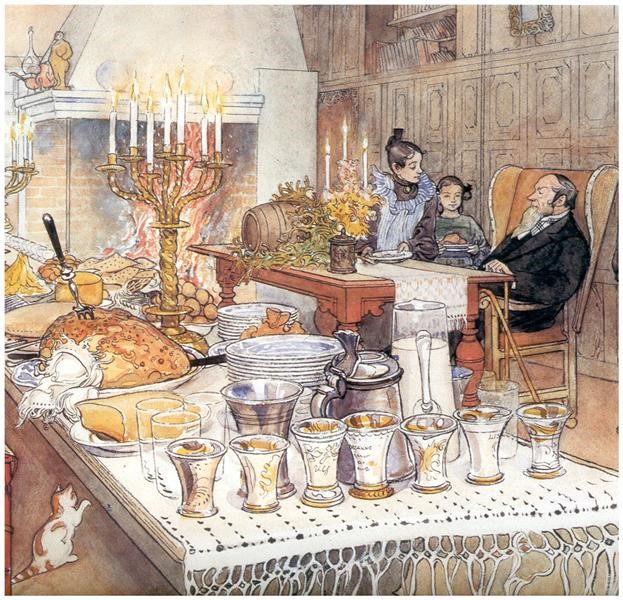
painting: Carl Larsson
PARENTING GROWN CHILDREN: The children may be grown but we still have our issues.
The holidays–especially the two big ones in November and December–can loom as a misery for some families. The difficulty of travel, the forced togetherness at an endless meal, the anxiety over family infighting. There are joys, too, but for many of our adult kids who face long miles of travel with cranky children the holidays don’t loom bright.
Do they have to spend the holidays with us, their parents? That was the question raised in a NYT The Ethicist piece. The answer was penned by ethicist Kwame Anthony Appiah
For the writer of a letter to Appiah, there are issues about travel with young children and extended-family dysfunctions. At other times of the year, visits to parents are easier to pull off, calmer and friendlier. In answer to the reader’s query about the family’s obligation to travel forth at Thanksgiving, Appiah made two points that sum up our kids’ obligation to us at holiday times and ours to them.
Adult kids have special obligations to their parents; family ties matter morally. But those obligations are limited by feasibility, fairness and the interests of the adult child’s household.
Ethical “special duties” run in both directions: Parents should also avoid placing recurrent, disproportionate strains on their adult children, particularly when other, workable forms of togetherness exist.
Not being together for a holiday on a specific day is not the end of the world. A friend, whose kids live a four-hour drive away, doesn’t even bother with a family get-together. Her tradition is to go out to dinner with friends and call it a day. If I can’t make it to my family’s gathering point for the holiday (plane travel is sooo unreliable; the weather can be wicked), I’ll binge on Ken Burns’ American Revolution and store-bought stuffing mix plus I’ll FaceTime virtual hugs with everyone I’m not getting to see in person. At least I think that would keep me in good cheer.
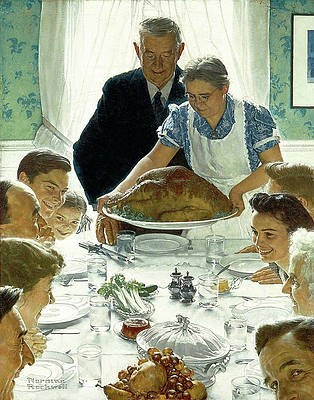
painting: Norman Rockwell
PARENTING GROWN CHILDREN: The children may be grown but we still have our issues.
So your adult kids are now young parents. Babies are gurgling; toddlers are beginning to walk, drunken sailor style. Pre-schoolers are making friends and picking up reading basics. For us as grandparents, this is such an exciting and joyful time. For some of us, though, it is tempered by our concerns that our kids’ parenting skills are not what we’d like them to be. They aren’t doing things quite the right way–or at least, not how we did them. Is it surprising, then, that when we offer our advice on a better way to, say, organize the grandkid’s toys or make sure the kiddies have cleaned their plates that our adult kids take affront. Joyful and exciting are replaced by tension and fighting.
Evidently, it happens often enough that Perri Klass, a pediatrician and a grandmother, has written a column on the point, “5 Common Mistakes Grandparents Make.” Even for those of us “not guilty” of any (or maybe just one) of the Five, the column serves as a gentle guide and reminder of how best to share our well-earned wisdom with our grown children, no matter the topic.
Here’s a summary of the Five Big Ones on Klass’s list:
Recognize that parenting patterns change with time. What was reckless for one generation may be conservative for the next one. Or vice versa. We may see the offer of cookies as a snack as a grandparenting indulgence while the parents may see it as a flouting of sugar-rules that are important to them.
Don’t blame your child’s partner. If you disagree with steps the parents are taking, remember the parents are a unit and that your adult child is one-half of that unit. If you have a suggestion to make, don’t go behind anyone’s back.
Don’t assume it’s the parent’s fault if a grandchild is struggling. “This is not the time to say “I told you so” or to point out that things in the home have been too disorganized or too strictly organized.” Our role is to be part of a support system.
Discuss important health issues with respect. You may disagree with the parent choice about immunizations or other important health-care steps. “These can be very hard conversations — in the home as well as in the pediatric exam room — and you have to try to stay respectful, be clear that you’re speaking out of love and concern, make your case, leave the question open if necessary and return to it — and don’t let it dominate the relationship.”
Don’t weigh in with advice too often. Pick your battles carefully and, for the most part, wait to be asked for advice. “There may turn out to be issues along the way, but choose those topics carefully — and pick your words with even more care.
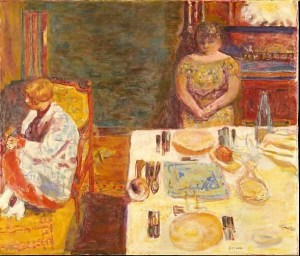
painting: Pierre Bonnard, The Conversation
PARENTING GROWN CHILDREN: The children may be grown but we still have our issues.
There are reasons — let me not count the ways — why our adult children may stop talking to us, avoid all contact (even blocking us on their cell phones), or enter what’s called “low contact” mode. They may decide to stay away from family get-togethers–or we might not want them to join us.
Whatever the range of actions or words that set them (or us) off on this path, the resulting estrangement is painful. It may even feel shameful. Sometimes time mellows the “misunderstandings,” but too often the inflammatory words or toxic actions that occurred–be it yesterday or years ago–get charged and recharged, especially around the holidays. Resentments grow and become embedded in the web of family relationships.
The experts who study the field don’t know how exactly how prevalent estrangement is but even using the lowest estimates, it’s significant, according to Psychology Today. What’s more, the latest studies on parent-adult child estrangement are discouraging because they suggest that breaches are becoming normalized.
“In the generations prior to the baby boomers, there was a very strong norm of family solidarity – that blood is thicker than water. Those norms have weakened,” Karl Pillemer, a Cornell University sociologist, noted in a BBC article.
Where estrangement was once kept off the cultural radar, today it’s more likely to be out in the open–thus normalizing it.
Now there are concepts like “toxic relationship” to describe an unhealthy parent-child dynamic. “Parental mistreatment” ranks high among the acceptable reasons for pushing parents away, as does “not respecting their rules,” especially with grandchildren.
In his research, which included a survey and in-depth interviews with 300 estranged people, Pillemer found it is not so much a devastatingly toxic relationship or event that causes the breakdown of family ties but rather a “build-up of minor negative interactions.”
Feeding into normalization is a form of narcissism. Rising individualism may also drive estrangement, according to.Joshua Coleman, a clinical psychologist who works with estranged families
“The culture of individualism is a preoccupation with one’s own self, one’s identity, one’s own happiness,” Coleman argues. “And so our relationships with other people are considered secondary.”
Let’s not forget the outside influences that can inflame a difficult relationship. Social media makes it easier for an alienated adult to find a tribe of like-minded people online, and many influencers encourage cutting ties with “toxic” people–whether they’re a parent, sibling or other family member..
The news is not all doom and gloom for parents who hope to reconcile with an estranged child.
A 2022 study of 8,500 people in the US estimated that 62 percent of those who were estranged from their mothers and 44 percent who were estranged from their fathers ended up reconciling for at least some period of time.
Hopefully, this was engendered and sustained by healthy doses of empathy, self-reflection and a willingness to listen–on both sides.
The NYT recently ran a list of four books on family estrangement. Here are the titles:
“Home Truths” by Lucy Blake
“Fault Lines” by Karl Pillemer
“Family Estrangement” by Kylie Agllia
“Rules of Estrangement” by Joshua Coleman
Painting: Pierre Bonnard, The Late Interiors
PARENTING GROWN CHILDREN: The children may be grown but we still have our issues.
Let’s call this a variation of the King Lear dilemma. How do we divide our estate so that all our children are treated fairly, particularly if there are reasons not to split everything evenly.
If we have two sons and one is killing it as a venture capitalist and the other is doing good work for an underfunded advocacy group, it may seem fair to leave more to the “non-profit” son than the venture capitalist.
Or, one child may be more attentive to the parents than the other. That is, one child may have neglected his aging parents for years while the other has shown up for weekly dinners, come by to watch a movie together or been there to help with doctor visits.
In this somewhat privileged world of ours, there can be other wrinkles. A dad wrote Philip Galanes at Social Qs about his three sons. Two stand to inherit sizeable amounts from their well-off mom–the dad’s divorced wife–but the third son has a different mother who is not well off. The dad wonders whether he should “even things out” out by leaving a greater portion to the son with the not-wealthy mother. “I want all of them to be comfortable when I’m gone,” the dad writes, “but I worry that my older sons will be hurt if I leave more to my youngest son.”
There is nothing wrong in dividing an estate unevenly (even if Lear botched it). The problem is that money talks and it can whisper “favoritism.” We may not be here to witness the trauma but at least one of our kids may come away feeling that the way we parceled out our treasures is a reflection of parental love.
If we want to go the “uneven” route, there is a simple measure we can take to make sure that when we’re no longer here, our kids feel we loved them equally. In the case of the several-mother situation, well, there’s is an additional consideration.
Let’s start with the all-purpose general advice and then let Galanes chime in on the specific.
One Size Fits All: No where is it written that the details in our will or the division of our estate must be kept secret–except in movies where the surprise of disinheritence or the leaving of a fortune to a beloved housekeeper is the melodramatic turning point in a story. (These scenes invariably take place in a lawyer’s office. Does that even happen anymore?). This is a long way of saying, we should talk to our kids about our estate plan while we’re still available to explain our reasons and to make adjustments.
Stay Focused: In the case of the sons with different mothers, Galanes points out, “for better or worse — and probably for better — you are not creating an estate plan with your ex-wife. And while you believe that she is “financially comfortable” now, that may change depending on her health and other circumstances as she ages. (The same can be said of you.) I suggest focusing on what you actually control here: namely, your own finances.”
painting: Ferryman by Ivan Canu
PARENTING GROWN CHILDREN: The children may be grown but we still have our issues.
Too fat? Too thin? Some of us are unhappy with the state of our adult child’s body. We remember when they were oh-so-fit soccer players, runners and dancers. But now, are they eating too much? Overindulging in junk food? Are they sitting around playing video games instead of jogging. It’s so tempting to remind them that they could diet or exercise their way back to fitness. We may work ourselves into a state of anxiety over what their body weight means for their health and/or their romantic happiness–and what we want to share with them in terms of ways to correct the imbalance in their body size. .
Readers, Don’t go there. To that end, I offer observations on the subject from three advice columnists. First up: Philip Galanes from Social Q. He is answering a reader who complains that people often comment on her and her family’s height (they are all tall) and her middle school-age child finds it upsetting, but his observations apply to weight and other comments about physical appearance. , Galanes writes
For 17 years, I have advised readers that unbidden comments about others’ appearances are unwise. We never know what people are going through or how our observations will affect them. Even purported compliments — “What long legs you have!” — can trigger insecurities and private pain, even though that’s not what the speakers intend…..
Yet, for 17 years, I have met with steady resistance. Many readers believe that they are entitled to give compliments and to be curious (“Just how tall are you?”). Some even assert that they are making the world a friendlier place by butting in.
Next up: The always reliable Carolyn Hax. A young woman wrote Hax to complain that her parents have been harping about her body size ever since she was a child and now have added the suggestion of taking GLP-1 drugs, such as Wegovy, Ozempic or Mounjaro. Hax is not buying it:
Parents have no business discussing adults’ weight unless invited, much less harping on it.
Should the reader try a GLP-1? Her doctor’s is the only outside opinion that counts.
Third expert: the NYT’s Ethicist ,Kwame Appiah. His reader writes that he longs for the day when his daughter was a lithe and graceful ballerina. As an adult, she’s overweight and his concern is for her health: There is a family history of diabetes on both sides. Appiah sees a little wiggle room for weight discussions given the bona fide health concern. His suggestion:
Speak to her as an adult, with respect and candor, rather than as a child whose body you wish were different. That means keeping the focus on health and family history. Make sure she knows the concern comes from love, not disappointment — that your concern is for her well-being, not her waistline.
photo: Maia Lemov
PARENTING GROWN CHILDREN: The children may be grown but we still have our issues.
If you have a 20-something hanging around your life, chances are 50-50 you’re getting your cultural and political news from different sources. If the young person is a grandchild, the odds go to 99-1. I’m making up the numbers but the point is that our older generation gets information about the world from very different sources than younger ones do and those sources don’t necessarily have the same outlook or rely on the same set of facts.
Most of us kinda know this but what does it mean? Is it just some bit of perceived wisdom or cliche that we mouth at social gatherings? Does it impact our lives in any way? The stakes of this info gap were brought home to me not by a chat with a 20-something but, oddly enough, by a reaction to my daughter’s book.
This past March, her book, The Instability of Trutharrived in bookstores (and on Amazon). It’s about brainwashing, mind control and hyper-persuasion. As part of her campaign to bring the ideas in the book to a wide swath of the public, my daughter went on a podcast blitz and landed most prominently on the Joe Rogan Experience,. Rogan’s show is one of the top five podcasts in the country and one which hews right/conservative and young male.
A few days after the podcast hit the internet, my daughter’s nephew texted her. HIs message: His friends thought it was cool that his aunt was on Joe Rogan. A week later, she was on a zoom call with an alumni group from her college when one of them told her, “My 22-year old was star-dazzled when he heard I was going to be talking to you. He’d heard you on Joe Rogan.”
Step back with me now to the media world of my generation. When the book came out, a few of my friends called to say how delighted they were to see it discussed in the New York Times and New Yorker. When I mentioned to other friends and colleagues that she had been on Joe Rogan’s podcast, the response was befuddlement. One said, “Oh, is he the guy who claimed the Sandy Hook shootings were a hoax?” No, that was Alex Jones. Others knew who Rogan was by reputation and asked if he had bullied her on the show. No, he had not. He and she had a polite and serious conversation, a portion of which centered around MK-ULTRA, a clandestine CIA mind control program circa the 1950s. MK-ULTRA has been one of Rogan’s long-standing interests and is probably why she was invited on the show.
Clearly, there is a wide gap between what older and younger generations see, read and listen to and their sources delivered information about my daughter’s book in very different ways. The traditional way told us what to think generally about the book and its ideas. The newer way discussed some of the book’s content based on the perspective of the podcast host. There was little crossover or room for discussion between the readers (of the reviews) and the listeners (of the podcast).
As many of us know from keeping our eyes and ears open, Gen Z does not read traditional newspapers or tune into the 6:00 evening news. They get their information via social media sites as well as podcasts and substacks. Most of my generation (aging boomers) is on a well-worn path where we trust institutions to bring us news that’s reliable and vetted. Do we and our adult children and grandchildren have a common base to discuss the response to a book on brainwashing to say nothing of what’s happening in the world?
Generation Z is not going back to the way things are for us. It will be up to us to bridge the gap, to stay abreast of their world by tuning into their sources of news and information. I can’t say I’ve become a Rogan regular, but I am trying to add to my news intake thought-stretching podcasts and news from social media sites. Here’s hoping I’m not sucked down a TikTok rabbit hole.
painting: Elizabeth Catlett, “Links Together”
PARENTING GROWN CHILDREN: The children may be grown but we still have our issues.
When our kids are planning to visit us–be it to drop by for an hour or to come home for a weekend–we’re usually alive with anticipation. Ah, the the joy and positive energy a visit brings. The question is, are they feeling as positive as we are? Yes, they are! That is, they share in the delight of a visit when we set the right mood and tone. That’s the gist of a column I came across headlined with these practical words: 7 things older parents can do that make their adult children enjoy visiting them. Cuts right to the point, doesn’t it. It’s up to us to make it work..
Here’s a summary of the seven points. No one–least of all me–says all of them are easy to execute, but we can try:
Be welcoming: Keep things light and warm. Don’t let irritants rise up and dominate the conversation.
Cross no boundaries: If they want to talk about something deeply personal, they’ll let you know. Don’t be the one to bring up their touchy subject.
Tell family stories: It’s fun to share anecdotes about the family and their childhood but they should be fun stories you can all laugh about, not stories that double as lectures or could embarrass them.
LIttle things mean a lot: Have small things on hand that remind them how welcome they are–be it a snack or a favorite pillow.
Be an engaged listener: Pay attention to whatever it is they’re talking about–even if you’ve heard it before and even if the dog is asking for attention.
Stay away from old arguments: Social visits are not a time for conflict resolution.
“Let them know you’re happy to see them: “I’m so glad you’re here.” Saying that goes a long way in setting a comfortable and comforting tone.
Painting: Renoir, The Boating Party.
PARENTING GROWN CHILDREN: The children may be grown but we still have our issues.
Our closets are full. So is the attic, basement and every cranny that can hold papers, memorabilia and photo albums. To say nothing of unused dishes, scarred pots and chipped figurines.
Getting rid of some or all of that stuff is formidable. It looms like a climb up a mountain of slag. And yet, do we want to leave that paring, parsing and purging to our kids. They’re likely to have it all hauled away–the valued treasures as well as the junk.
If the clearing out is part of a plan to move to a smaller space–from a house, say, to an apartment–here’s something to keep in mind, especially if you’ve accumulated a lot of collectibles. On average, most of us take 25 percent of our belongings with us to our new homes. Of the 75 percent left, there is usually a market for about 60 percent, according to an estate planner who helps families downsize and sell off valuables.
Here are some tips, thanks to a Washington Post piece and other sources on how to get the purging and parsing underway.
Take it slow: Take a gradual approach. Part of the process is a walk down memory lane. Allow yourself time to process both the good and bad memories. Besides, speeding through a purge could cause you to toss away something meaningful or valuable by mistake.
Think Piecemeal: Working through one small stash of stuff at a time can keep the project from feeling overwhelming
Call the expert: For items that are valuable — or for those of us with a high volume of belongings or collectables — it can help to bring in an estate expert who can take items to auction or sell them online.
Say no more: Some of your adult kids will be pleased — even touched — to be offered one or two of the collectible or valuable items piece by piece. But they may also see your treasures as clutter-transfer. If they agree to take some stuff and you don’t see it displayed at their house, don’t ask about it. Let sleeping treasures lie.
FeelGood: As to the donate-to-charity pile, it’s often easier for us to let go of stuff if we remind ourselves how useful these items will be to someone else. When my husband passed away, I gave his winter coats and sweaters to a church that distributes clothing to the needy. It was comforting to know his clothes would keep someone else warm.



 PenPenWrites