There are reasons — let me not count the ways — why our adult children may stop talking to us, avoid all contact (even blocking us on their cell phones), or enter what’s called “low contact” mode. They may decide to stay away from family get-togethers–or we might not want them to join us.
Whatever the range of actions or words that set them (or us) off on this path, the resulting estrangement is painful. It may even feel shameful. Sometimes time mellows the “misunderstandings,” but too often the inflammatory words or toxic actions that occurred–be it yesterday or years ago–get charged and recharged, especially around the holidays. Resentments grow and become embedded in the web of family relationships.
The experts who study the field don’t know how exactly how prevalent estrangement is but even using the lowest estimates, it’s significant, according to Psychology Today. What’s more, the latest studies on parent-adult child estrangement are discouraging because they suggest that breaches are becoming normalized.
- “In the generations prior to the baby boomers, there was a very strong norm of family solidarity – that blood is thicker than water. Those norms have weakened,” Karl Pillemer, a Cornell University sociologist, noted in a BBC article.
- Where estrangement was once kept off the cultural radar, today it’s more likely to be out in the open–thus normalizing it.
- Now there are concepts like “toxic relationship” to describe an unhealthy parent-child dynamic. “Parental mistreatment” ranks high among the acceptable reasons for pushing parents away, as does “not respecting their rules,” especially with grandchildren.
- In his research, which included a survey and in-depth interviews with 300 estranged people, Pillemer found it is not so much a devastatingly toxic relationship or event that causes the breakdown of family ties but rather a “build-up of minor negative interactions.”
Feeding into normalization is a form of narcissism. Rising individualism may also drive estrangement, according to.Joshua Coleman, a clinical psychologist who works with estranged families
- “The culture of individualism is a preoccupation with one’s own self, one’s identity, one’s own happiness,” Coleman argues. “And so our relationships with other people are considered secondary.”
- Studies suggest that older parents in the US are more than twice as likely to have a bad relationship with their children than parents in slightly less individualistic countries such as Israel, Germany and the UK.
Let’s not forget the outside influences that can inflame a difficult relationship. Social media makes it easier for an alienated adult to find a tribe of like-minded people online, and many influencers encourage cutting ties with “toxic” people–whether they’re a parent, sibling or other family member..
The news is not all doom and gloom for parents who hope to reconcile with an estranged child.
- A 2022 study of 8,500 people in the US estimated that 62 percent of those who were estranged from their mothers and 44 percent who were estranged from their fathers ended up reconciling for at least some period of time.
Hopefully, this was engendered and sustained by healthy doses of empathy, self-reflection and a willingness to listen–on both sides.
The NYT recently ran a list of four books on family estrangement. Here are the titles:
- “Home Truths” by Lucy Blake
- “Fault Lines” by Karl Pillemer
- “Family Estrangement” by Kylie Agllia
- “Rules of Estrangement” by Joshua Coleman
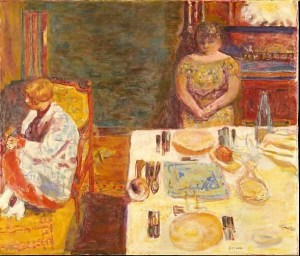
Painting: Pierre Bonnard, The Late Interiors
 PenPenWrites
Leave a comment