PenPenWrites

parenting blog, memoir notes, family punchlines & more

© Penelope Lemov and Parenting Grown Children, 2025. Unauthorized use and/or duplication of this material without express and written permission from this site’s author and/or owner is strictly prohibited. Excerpts and links may be used, provided that full and clear credit is given.

  • PARENTING GROWN CHILDREN: The children may be grown but we still have our issues.

    When Carol heard from a friend about a job that suited her son, she got in touch with the 22-year-old immediately. He was finishing up a one-year internship in another city; the new job–a year in a Middle Eastern country teaching English to Arabic-speaking children–would start two weeks after the internship ended. But her son was less than enthusiastic when she called with the lead–even though he loved spending his junior year in Egypt studying Arabic. Instead of thanking his mother for the tip, he told her the job was "teaching spoiled rich kids English so they could pass their SATs and get into college here. No thank you."

    His mom's reaction? "It was all I could do to say, if you don't apply for this job, don't bother to come home" when the internship ends. "How long does he think we're going to support him?"

    isn't that the ultimate question? If we're providing a free-rent nest for them to live in while they are job hunting, how much influence should we have in what they apply for and the decisions they make about taking one job and not the other–or none at all. When Carol asks her son what he's doing about job hunting, his curt answer is, "I don't want to talk about it." Clearly, he is anxious. It took him months to get the paid internship–after applying for what seemed like 100s of jobs. Now, he's had a year of living on his own. Could he really want to come home and bunk in with mom and dad again? Is he right, as his answer suggests, that he should not take a job that he sees as wasting a year of his life.

    And yet, from his mom's perch, he's not doing anything to get on top of things. "He's given up," she says. And when she compares what he's doing now with what she did as a young woman on her own–he comes up looking like he has thrown in the towel, doesn't care or is content to freeload. But these are different–and difficult–times. Our experiences when we were their age may not apply. Is a tough love approach a better one? Maybe she should tell him he can't come home again–that he has to take a job, any job, like it or not, and support himself.

    It's not just tough love. It's a tough call.

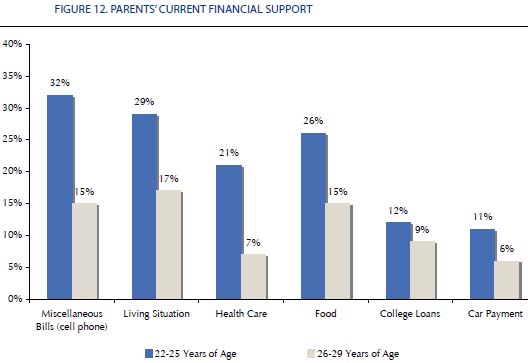
    Meanwhile, Carol is certainly not alone in helping to support her grown child. The New York Times ran a piece recently headlined "A Generation of Slackers? Not So Much," that touched on these issues. The Times also ran a chart, based on a survey by Rutgers University, on its Economix blog that shows what parents, circa 2010, are doing for their grown children.

    DESCRIPTION

    “Unfulfilled Expectations: Recent College Graduates Struggle in a Troubled Economy,” Heldrich Center for Workforce Development, Rutgers University.

    Some other findings from the Rutgers study: 60 percent of the graduates of the college classes of 2006 through 2010 said they held a part-time job while enrolled in school, not including jobs held during the summer or between semesters. Another 23 percent said they were working full time or both full and part time during school. For 44 percent of students, work or personal savings helped finance their schooling. "Today’s young people," said Carl Van Horn, a labor economist at Rutgers and co-author of the study, "are very focused on trying to work hard and to get ahead.”


  • PARENTING GROWN CHILDREN: The children may be grown but we still have our issues.

    I used to joke that senior year in high school was designed to make parents willing to part with their kids. It was my way of taking the edge off the blue feeling of an empty nest. But those blues didn't last all that long. Most of us find the up side of our new situation–time to do things we always wanted to try, and when we want to try them. It could be grabbing the watercolor paints and heading for a hill or breaking out the wine and cheese and calling it dinner.

    Though the "empty nest syndrome" is supposed to be one of the major adjustments of life–we miss the little critters and their soccer games, swim meets and theatrical performances–but researchers now say that the empty nest syndrome is a fiction. Not that our children–the birds finally out of the nest–don't think we're suffering from it. Karen Fingerman, a psychologist at Purdue University who teaches classes on family issues, asks incoming freshmen how they think their parents are doing now that the children are in college. Every year, the students answer almost uniformly: They must be "devastated" by our absence.

    But in fact, Fingerman's research finds that we the parents are thriving–and with good reason: All that teenage tension has left the building. While we may experience wistfulness for the excitement they brought into the house–their music bouncing off the walls, the buzz of their endless telephone chitchat–scientists are coming around to the view that even among women who devote all their time to raising kids, there is no empty nest syndrome. Instead, there is a feeling of satisfaction at a job well done: The kids are independent!

    Fingerman fingers another source of the positive vibe: As we get older, she says, "we get better at emotional regulation." Moreover, a lot of the volatility that had been in our lives when we were younger has diminished–we're more settled. By the time our children are young adults, most of us know where our careers are heading, where we're going to live and with whom. The empty nest gives us time and chance to reach out and bring more activities and relationships into our lives. We may start reconnecting with old friends, relatives we haven't seen in years. And tracing the family tree–an activity that's grown a thousand fold in recent years, made possible not only by the Internet but by the energies and interests unleashed by no longer having our kids–and their tensions–in the house.

  • PARENTING GROWN CHILDREN: The children may be grown but we still have our issues.

    Paterfamilias and I have taken to avoiding certain restaurants on Sunday nights. Usually Chinese. Usually filled with families.The orange beef and the shrimp with snow peas, the pork fried rice and the chicken with cashews fill a lazy susan that goes spinning around from the Bubbe and the Grandpa to the mother nursing an infant to the 8-year-old in a baseball cap. Oh, to have our children living close by. Oh, to be taking them out to dinner on a Sunday evening. Or having them over for a cookout. But our grown children and their children live in other cities that are too far away for a Sunday evening dinner.

    Well, you can't have what you can't have. And we have Skype and phone calls and weekend visits every six weeks or so. It's not Sunday evening outings, but it will have to do.

    I found solace in the chuckle in this tweet from a Twitterer named Aging Abundantly:  "Happiness is having a large, loving, caring, close-knit family — in another city." George Burns.  Burns was a vaudeville and radio comedian who lived to be funny well into the era of TV. {He lived to be 100.]. He personally missed out on Twitter, where he would have been one of the greats. So glad to see he's not being overlooked. And can still make us laugh at our human predicaments.

  • PARENTING GROWN CHILDREN: The children may be grown but we still have our issues.

    We've lived through the adolescence thing. We don't want to face that experience again, but there's the threat of doing so if we have a young adult in or around the house–or a fully grown adult child living or visiting the home front. Close proximity can create frictions that simulate some of the tumult of those teen years. That's why I was drawn to points made in a recent column by psychologist Carl Pickhardt, who writes about dealing with adolescence on his blog on Psychology Today's Web site.

    A recent one had to do with little things that mean a lot–namely courtesy and the importance of it in our interchanges with our family members. He may have been aiming specifically at an adolescent in the home, but the points he makes in Adolescence and the power of parental courtesy, would seem to apply to dealing with grown children no matter the age.

    "Courtesy behaviors," he writes, "are those small gestures that define how thoughtfully people treat each other on a daily basis."

    What behaviors is he talking about? Here are his examples:

    Would you rather be told to give help or be ASKED to give help?

    Would you rather be interrupted or be LISTENED to when saying something important?

    Would you rather be ignored or be NOTICED for the special gesture you made? 

    Would you rather be criticized or be COMPLIMENTED for trying your hardest?
     
    Would you rather be taken for granted or be THANKED for doing a favor? 

    Would you rather be untouched by a loved one when feeling sad or be HUGGED?

    Acts of common courtesy, he suggests, "contribute to quality of family life by causing the giver to act thoughtfully and the receiver to feel treated with consideration."

    As the grown kids head home from college–or the once-independent grownup moves back home with mom and dad for a while, it doesn't hurt to remember those little ways of framing a request or a thank you. Miss Manners would approve.

  • PARENTING GROWN CHILDREN: The children may be grown but we still have our issues.

    It all started with a Washington Post's Kids Post on robots and the cool things robots can do–play soccer, solve Rubik's cube. When she was visiting her grandkids, Lee read it over with them and discussed with them their ideas about what they would want a robot to do if they had one. The Post asked readers to send in their ideas and the grandmother and her grandchildren complied. Lee thought the Post would compile the answers and let its readers know that X number of children wanted a robot to cook for them and X wanted them to play chess, etc. But Post editors picked out a dozen answers that they found engaging and printed them–with the names and home town of the children who made the suggestions. Lee's grandkids made the list.

    That's when Lee ran into a boatload of trouble. Although her grown son had been present for the discussion, her daughter-in-law hadn't. When Lee showed her daughter-in-law the contest results in the newspaper, her daughter-in-law became enraged: yelling, screaming, angry at Lee. She had not been consulted about sending the information in, but more important, she never, never, never allows her children's names to be published online or anywhere. Ever.

    Lee was stunned. She explained, she discussed and then she apologized. Several times. She cried all the way home, she says. The apology was finally accepted the next day when Lee agreed to call the Post and have her grandchildren's names removed from the online version.

    Lee tells this story at lunch with two friends who are also grandparents, and our small group is shocked by the daughter-in-law's reaction. Except that we shouldn't have been. Many young parents today see the Internet as a dangerous place for their children to be–to wander through without supervision, of course, but also as a place where their names or, worse, their photos could appear. They see predators lurking everywhere on the Internet. This is a big issue on Facebook. Parents are very careful with privacy settings when it comes to family news and photos. I asked my daughter–mother of an 8-year-old Grand–her reaction to Lee's story. She says she wouldn't have been angry, but she did understand the concern about letting your child's identity get out of your control.

    I also repeated Lee's story to a couple–Elliot and Ann–we were having dinner with that evening. Just as I got to the part where Lee showed the newspaper to her daughter in law, Elliot interrupted with a shout: "She was furious! She didn't want her children's names in the newspaper!" Turns out, his kids are the same way. Ann added that she had been invited by friends at work to open a Facebook group page so they could swap personal information and chit chat. When her daughter-in-law got wind of this, she objected and asked Ann not to do it. Why? What else would the women talk about but their grandchildren–and post photos of them as well, and she didn't want her children's names or photos online. Ann, who says she doesn't understand Facebook anyway, didn't join the group.

    As our grown children make their way through the perilous child rearing years, we stand ready with advice from the wisdom of our experience. We are there to guide them around the shoals of childhood and teenager-dom–as we remember them. But here is something with which we have no prior experience–and little understanding of the fear behind it. It's a whole new world out there.


  • PARENTING GROWN CHILDREN: The children may be grown but we still have our issues.

    The complaint comes not from the mother of the son who has returned to the nest. It comes from the sister. The brother, a recent college grad, has a low-paying, late-night-shift job and can't afford to rent his own place. So he's moved back home with mom. His girlfriend is the problem. She doesn't officially live with the brother but she's there all the time–and she sits in his room all day, stoned, the sister says. She wants to know what her mother can do about this inappropriate and unhealthy situation–a situation that bothers the mother. The sister/daughter writes Carolyn Hax, a Washington Post advice columnist,that her mother "is at a loss as to how to confront my brother and this girl without stomping on his nascent adulthood and causing a huge fight."

    Ah, yes. The "trampling" on the "nascent adult." Just what so many of us face when college students, young adults or emerging adults move home while they come to terms with where their life is going–and all the anxieties that accompany that: for them and us. It's a problem. We don't want to step on their toes, but when they start stepping on ours or we are confronted with unhealthy choices they are making, we may have to do some trampling–nuanced and with some with some emotional subtlety–but nonetheless something that addresses the point.

    Here's Hax suggestion: Mom needs to treat son like an adult, not as an emerging one. She could say something straightforward and non-emotional, like, "I've said nothing about your girlfriend's staying here, hoping you would recognize for yourself that it is totally inappropriate for her to sit in your room, full-time, stoned…Please steer her out of your room, and ideally to some help, or else I will have to get involved."

    Hax's point–and it's one I find worth remembering–is this: Don't get sucked into an argument. That would send the message that the mother sees her son as fragile, and that would undermine her respectful intent.

    To say nothing of trample down hard on his nascent adulthood.

  • PARENTING GROWN CHILDREN: The children may be grown but we still have our issues.

    "I was no pushover," a friend tells me. "When my children were small, I had all my nick-nacks out in the living room and I taught them not to touch them. They never did." That said, she says her children's approach to disciplining their children makes her so uncomfortable she no longer enjoys visiting them.   "Both my daughter and my son are so strict and about such minor things," she says. Moreover, when she is in their house, she is expected to enforce the disciplinary rules of the house. "They expect me to be a third parent. But that's not who I am. I'm the grandmother."

    She has written her daughter a lengthy email on this point–written when she had calmed down after an unpleasant confrontation over what was expected of her when she babysat. In the aftermath of the email, promsies have been made to make sure she does not feel–and is not expected to be–a third parent.

    She has come up with other solutions to her problem. Rather than visit in her daughter's house, she invites her grandchildren–they are 9 and 11–over to her house by themselves for a special treat with grandma. Or she arranges to take them out to a movie or for lunch–on their own.

    Her son, however, lives half way across the country. His son–her grandson–is only two years old. Right now, she has decided to call a temporary halt to visits. She can't stand to see him corrected and punished for refusing to eat zucchini or forgetting to ask to leave the dinner table or misthrowing a ball beyond his indoor play area.  "He holds out his little arms to me, crying–and all he's done is mis-throw a ball. He's only 2!"

    It can be painful to watch your children parent. Either they don't impose enough disciplinary measures–raising your concern that your grandchildren will be brats. Or, the discipline comes with too heavy a hand–raising your concern that your grandchildren will turn into frightened robots. We also don't have the back story–which issues have been festering without our knowing about it.

    One grandparent I talked to about the discipline dilemma made this point: "As much as we'd like to, we can't always come to the rescue of our grand/grands. All we can do is to make the best of what time we have with them without making them feel they can expect us to break their parents rules. This could cause conflict between parents and grandparents, and we wouldn't want this, as this may cause us not to be able to see them." It's also an issue discussed on About.com's grandparenting

    Grandparenting may mean we get to go home before the meltdowns start. But it also means we have no say in how the kids are being brought up–no matter how painful it is to watch.


  • PARENTING GROWN CHILDREN: The children may be grown but we still have our issues.

    When her son graduated from college, Norma says he was all at sea–he had no idea what he wanted to do. He'd been a good athlete in college–he was a star on his school's baseball team–and earned good grades, but all that discipline and focus didn't add up to a career choice.

    Norma, who is my physical therapist, is also my new "best friend": We spend an hour with each other, twice a week. While she works on my sore leg and back, we get to talking about a lot of things. She would like to cut back on her hours, but she can't: She and her husband are supporting their son, who lives in New York. And New York, Norma tells me, "is very expensive."

    Six years ago, her son went to Big Apple to visit some fraternity brothers who were there trying to make their way in the world. One was working at a radio station that had an opening in its sport research department. Her son knew a lot about sports, got an interview and the job, and moved to New York.

    The job didn't pay much. Norma and her husband helped out. They paid his rent–they wanted him to live in a safe neighborhood, so the rent was sizable–and his credit card bill. "Lots of charges for bars and meals out–he doesn't cook," Norma says. The job was just for a year. When it ended and her son was out of work, Norma suggested he get a job at Starbucks or something like that to earn a little extra money. He didn't want to. He now had a career in mind. He took film-editing classes and within a year  landed a job with a television production company. He's been there four years now, but he still can't make it on his own. He pays his own rent now, but Norma and her husband still pay the credit card bill. The good news: they are seeing fewer bar charges on the card. He now has a girl friend and she cooks. Norma hasn't met her yet but it sounds "serious." The girlfriend is from Los Angeles and has a sous-chef internship at a restaurant. But her job is not exactly a high-paying one. Norma asked if they were thinking of moving in together. They are not–they are not ready for that level of commitment, although a move would make financial sense. The people it would make the most fiscal sense to, however, are Norma and her husband and the girl's parents–they're supporting her.


  • PARENTING GROWN CHILDREN: The children may be grown but we still have our issues.

    One of the trickiest parts of parenting adult children is recognizing that we are no longer the center of the family universe, that our grown children are now the sun and stars. We are revolving around them.

    In her 2008 book Patriotic Grace, Peggy Noonan wrote about politics and our need to face common challenges together. But she might as well have been talking about parenting adult children when she wrote: "There is even a feeling, a faint sense sometimes that we have been relegated to the role of walk-on in someone else's drama, that as citizens we are crucial and yet somehow…extraneous."

  • PARENTING GROWN CHILDREN: The children may be grown but we still have our issues.

    "What does he see in her?" 'How could she go out with him?

    As our kids move through their "serious" dating years–as they prepare themselves to find and settle down with Ms or Mr Right–we may get to meet a lot of their romantic interests. The historical  marriage age, after all, has moved up to 26 for women, 28 for men, and that could mean we'll witness either one or two long-term relationships or a lot of serial dating. Few of the "interests" will meet our criteria as worthy of our precious child's love and devotion. We inevitably set a high bar. But even so, some will fall far far below it. And the longer the relationship lasts, the more tempted we'll be to try to steer our child away from a mistake.

    Not a good idea. As we all know, even if we can't help ourselves, negative input from mom and dad is likely to push two young people together. But what's a parent to do? I recently read some good tips on the subject in an AARP posting by Jeffrey Jensen Arnett, who's been a leading voice in research on "emerging adulthood," and Elizabeth Fishel, a writer on family issues. Here are some highlights beyond the "keep your opinions to yourself" stuff:

    "If you must say something, comment on what you observe, rather than on the person in question…such as: "He puts you down" or "She interrupts you."  Sticking with observed behavior gives your son or daughter room to open up — or tell you to back off.

    "Hold the judgments and…listen with empathy. We call this approach "friends with barriers," and it's all about the delicate balance between support and intrusion, between staying connected and being overly invested in your emerging adult's every move.

    "Ask yourself what your child's relationship is providing that you're not seeing. Just considering this question reframes your perspective from criticism to greater understanding.