PenPenWrites

parenting blog, memoir notes, family punchlines & more

© Penelope Lemov and Parenting Grown Children, 2025. Unauthorized use and/or duplication of this material without express and written permission from this site’s author and/or owner is strictly prohibited. Excerpts and links may be used, provided that full and clear credit is given.

  • PARENTING GROWN CHILDREN: The children may be grown but we still have our issues.

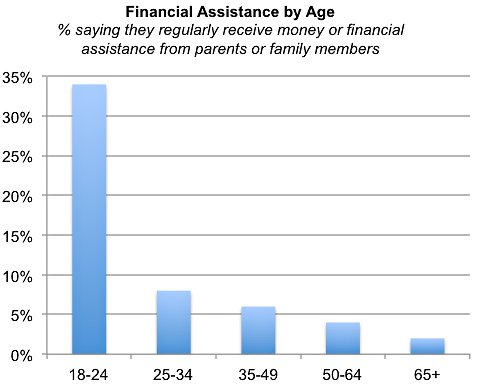
    Yet another confirmation of what many of us know: We are the generation that offers our grown children financial help. Pew Research Center's latest poll finds that one in 10 American adults receive money or financial assistance from their parents or other family members. The bulk of those receiving help are emerging adults–men and women in the 18 to 24 year old range. It falls off from there but doesn't stop–some of us are still getting help from our parents

    I'll let this Pew Research Center chart, courtesy of the New York Times, say it all:

    Based on telephone interviews conducted Dec. 6  to 19, 2011, with a nationally representative sample of 2,048 adults  ages 18 and older.
    Based on telephone interviews conducted Dec. 6 to 19, 2011, with a nationally representative sample of 2,048 adults ages 18 and older.
  • PARENTING GROWN CHILDREN: The children may be grown but we still have our issues.

    They're back. And they like the living conditions. According to a recent Pew Research Center poll,  68% of young adults ages 18 to 34 who are living with their parents or have moved back in temporarily because of economic conditions say they are very satisfied with their family life. (Roughly a similar proportion–73%–who are not living with their parents are equally satisfied.). Similarly, 44% of young adults who live with their parents say they are very satisfied with their present housing situation, while 49% who live on their own say the same.

    The Pew survey had more to say about the circumstances of young adults (18 to 34 years old) who've come home to re-nest. They are less likely than their counterparts who are living on their own to say they have enough money to live the kind of life they want. It's 21% of those living at home who say they have enough money now; 38%  of those who are not living with their parents.

    Not only are they satisfied, they're looking to the future with optimism. Says the Pew poll: "Living with mom and dad hasn’t dampened the economic optimism of these young adults. Overall, young adults are much more optimistic than middle-aged and older adults about their financial future, in spite of the tough economic times and difficult labor market they are facing."

    As for 'We the Parents', the poll finds we're just as satisfied with our family life and housing situation as are those parents whose adult children have not moved back home. The kids, they're pretty satisfied with their relationship with us. Here's the 'loving relationship' breakdown in chart form.


  • PARENTING GROWN CHILDREN: The children may be grown but we still have our issues.

    Spring break is here. Summer is a comin'. Many of us will be seeing more of our Grands–and for longer stretches of time as our grown children take a weekend off or need coverage when school is out. Heather Smith, a former nanny (see note below), has written a guest post to share five tips on keeping the grandkids occupied and amused. Most of them are probably things you already do with your Grands; but one or two may be something you hadn't thought of. Her bottom line is simple: "Don’t worry about keeping them entertained," she writes. "As technology-obsessed as they may seem, they’re still kids and they’ll enjoy all the same things you did growing up." Here are her tips:

    1. Play games: Even though kids seem to be completely encompassed in video games these days you’d probably be surprised how much they would enjoy playing board games or card games. Teach them how to play some of your favorite card games, or play games that everyone can join in on like Monopoly or Scrabble.

    2. Bake together: Little kids love to “play” in the kitchen, so baking together is the perfect time to let them test out their culinary skills. They’ll have fun mixing all of the ingredients together and you’ll have a chance to pass onto them some family-favorite recipes. Then when they’re older and have their own grandkids they can pass it on to them, and thus a tradition will be born.

    3. Visit a petting zoo: This one is almost always a guaranteed hit with the grandchildren. Not only will you be able to get outside and enjoy the outdoors but they’ll get to play with all sorts of animals. It’s the perfect way to spend a sunny afternoon together.

    4.  Look through old pictures: You may think that they have no interest in learning about the past, but you’d be wrong. Little kids will have a blast looking through all your old pictures and hearing you tell stories to accompany them. Sure they make think your clothes were weird, but they’ll also look back fondly on those memories.

    5. Go shopping: Let’s be honest, grandparents love to spoil their grandkids. Having them come for a visit is the perfect time to indulge in some quality time with them and spoil them with love and affection… and a few new toys! Then you can keep the toys at your house so they always have something to play with when they come over.

     Author Bio: Heather Smith is an ex-nanny who regularly contributes to various social media and parenting blogs/websites and to nanny service. She can be reached at H.smith7295@gmail.com.

  • PARENTING GROWN CHILDREN: The children may be grown but we still have our issues.

    "Why haven't our kids been able to get ahead in their careers?" a friend mutters. Her son is a filmmaker; her friend's son is a food photographer. Both men are in their 40s. Both men are being supported all or in part by their parents. Both parents wonder whether they should be paying the bills for their sons and their sons' families (one is married with children; the other is divorced with a child to support). Tough Love or a Helping Hand–or somewhere in between?

    The old answers don't seem to apply. In these harsh economic times–a jobless recovery and other hurdles–recent college grads in their 20s have had a tough time. Too many of them haven't been able to gain traction for an entry-level career job. Those in their 30s and 40s–and even older–have been losing their jobs or struggling to keep their enterprises going. And here we sit in or near retirement wondering whether to tap–or keep tapping–our slightly diminished nest egg to help them out. Do we sit back and let them struggle to move forward or do we give them a little cushion while they try to get going.

    No one wants to be an enabler–letting their smart and talented child get away with being lazy and content to feed off their parents. But where's the lazy line? My friends with the filmmaker son say he has been willing to take jobs that are beneath his skill level–wedding photography gigs and the like. His father worries that his son is giving up on his dream of film making.The son, he says, is uncomfortable taking his parents money and is doing what he can to get closer to standing on his own–even at the cost of his dream. The father adds this argument for his continuing to offer a Helping Hand: His son is his only child. He's going to get it all anyway, so why not help him out now? It gives the father a deep pleasure to underwrite his son's pursuit of his dream.

    Their friend's son, also in an artistic profession, is not as willing to take odd jobs–it's a professional photo shoot or nothing. He has a non-working wife, child and another child on the way; not an inexpensive household. Here is a case, my friend says, where a little Tough Love should apply. If he's not willing to take other jobs, his parents should not enable that behavior.

    Continued support for adult children is a tricky subject. It's not like the drifting 20-something who has yet to find his or her calling. That may call for Tough Love. These adults have put time and money into becoming professionals, but they haven't been able to make their calling pay off. When does a parent say: Stop. Enough. For my friends, it seems almost more painful for them to admit the son should give up on his dream than it is for the son. Are they just enablers? Or, when the economy picks up, will their son's dream take off?

    Stay tuned.

  • PARENTING GROWN CHILDREN: The children may be grown but we still have our issues.

    A recent online Forbes story  talked about charisma–who's got it (Steve Jobs, Marilyn Monroe) and whether it's teachable. (Reader alert: if I may have a wee bragging moment, it is teachable, and this writer's son was mentioned by the Forbes author as one who teaches it to teachers.) The author went on to posit why charisma is needed at home and whether there are pointers on charisma that we, as heads of families, can use to our advantage. "Something as elusive as a winning smile or a commanding gesture now can be broken down, frame by frame, into a series of smaller actions. Identify them, tag them — and presto: what once seemed mysterious starts becoming amazingly straightforward to emulate," the author writes.

    Then he applies the lessons to the home front–based on an interview with Olivia Fox Cabane, author of The Charisma Myth: How Anyone Can Master the Art and Science of Personal Magentism. He asked Cabane to help him fix what he called his latest charisma problem. "At a recent weekend brunch, a child had interrupted me in the midst of a grownups’ discussion. Even though I was seated at the head of the table, everyone turned to let the youngster take command of the conversation. Help, doctor! How can I repair this dreadful charisma deficit?"

    Since all of us with grandchildren have been there–or witnessed the "there"–some of us may take a keen interest in Cabane’s answer. It contained simple, precise advice: Lower the pitch of your voice, take deeper breaths and occupy more space "even if it means puffing out your chest."

    The author tried it, with this reported result: "Brunch at our house will never be the same again."

    I'm not sure we all want to risk frightening our little Grands or their little guests with puffed out chests and deep voices, but it beats waving a heavy disciplinary hand. And keeps the conversation flowing. A lesson it's healthy for our Grands to learn.

  • PARENTING GROWN CHILDREN: The children may be grown but we still have our issues.

    Someone's grown child wrote New York Times' Social Qs to complain. She's a medical student and so is her husband of three months. Both parents help with the tuition and, in varying ways, with day-to-day support. It's generous but also understandable. If parents can afford it, helping a child get through the high cost of medical school debt-free is a worthy investment. Her parents, she writes, send her a stipend every six months–no strings attached, though the understanding is that it will be used to pay for food, rent and the like. His parents, on the other hand, help out by paying his credit card bill. Her complaint: his parents scour the bill and raise questions about various expenditures, as in, "What did you buy at Banana Republic for $42?" She finds the queries intrusive and wants to know how to address the situation.

    I have a friend who was on the receiving end of a similar situation. A few years ago, when her son and daughter-in-law were both in medical school, she not only paid her son's tuition, but, when the couple had their first child, she footed the bill for child care–the better to help the young couple make ends meet and not have to cut corners on day care options. One day her daughter-in-law dropped by to show her a dress she bought for a wedding she was going to. My friend saw the price tag and started stewing. It was nearly twice the amount she would ever spend for a dress. “Here I was paying for day care so they could make ends meet, and my daughter-in-law goes out and splurges on this dress,” she says. “I resented it.”

    Marty Kurtz, who's president of the Financial Planning Association (and a personal financial adviser in Moline, Illinois), has an explanation for why we ask questions about the credit card bill and resent the price tag on the dress: “Control is a huge money-life issue,” he says. “It’s built into our psyche that money gives you control.” In effect, many of the supports we shower on our children are gifts, but gifts with strings—we want to be sure the money isn't spent on designer dresses or an extra set of tee shirts. We want it spent the way we intended it to be spent–even if we didn't exactly spell that out to begin with. Kurtz suggests we do the spelling out if how our children spend our gift is important to us.

    Philip Galanes, who pens the Social Q column, had a brief but perfect answer, to the medical student's query: "I hate when people pay my bills, too. Such needless generosity!Try saying, 'Thank you'–often."

    Is it piling on to say, Amen? And that "thank you" is the real string we'd like to attach.

  • PARENTING GROWN CHILDREN: The children may be grown but we still have our issues.

    On a Friday morning walk with friends, a fellow walker is talking about how her son deals with where and how his children explore sites on the Internet. Not only does he have parental locks on certain sites, but he keeps the computer in the living room–the main room of the house. Whatever some one is looking at is available to anyone passing by. Then change reared its head. For her grandson's 13th birthday, the other grandmother bought him a laptop to use in his room. He was thrilled. The parents–not so much.

    In this age of the Internet, we parents of grown children are innocents. We never had to deal with the risks the Internet poses: it's not just the availability of pornography or of the ability of unbalanced people to prey on children, but there are a host of privacy issues inherent in social media contact–to say nothing of concerns that what your grandchildren post today is out there forever, what they link to can be linked back to them, and that there's an impulse control issue: it's easy to say online what they wouldn't–and shouldn't–say in person. 

    My friend's son can't keep his teenage children "in the living room" forever. As Carl Pickhardt writes in a recent posting in Psychology Today on Parents, Adolescents and the Internet, "This isn't Kansas anymore. Computer travel on the Internet has vastly increased the field of play for adolescents, in the process vastly complicating the responsibilities of parents."

    I plowed through Pickhardt's piece as a way of sensitizing myself to what my grown children will be facing in dealing with their children and the Internet. I don't want to break a "house" rule or misunderstand why a rule (say, no computers in the bedroom) is in place. Here are some of the points I picked up about parental controls on Internet use:

    Gaming and the endless social networking may seem a waste of time to some of us, but it's part of a kids acquiring Internet proficiency.  "Any use is practice, but not all use is otherwise beneficial," Pickhardt writes. "However, competence on the Internet has become an essential life skill."

    For safety's sake, parents need to set rules for where on the Internet their children can go (and we grandparents should find out what they are): "Because the home computer is a major portal to the Internet, [parents] may impose conditions that prohibit certain destinations for the present, explaining why."

    Kids need to maintain a healthy balance of life experiences. "It's easy to sacrifice physical exercise, face to face socializing, creative self-expression, family time, household chores, and homework, for compelling Internet activity. At issue is the balance between how much of life is lived online and how much is lived offline."

     As part of the offline generation, we may encourage our Grands to be up and about in the real world, but we also need to stay up to speed on the online risks.

  • PARENTING GROWN CHILDREN: The children may be grown but we still have our issues.

    They have a will that tells their grown children how the major assets in their estate will be shared. But a few weeks ago, Jane and Lester took an additional step. They made out two lists. One they shared with their children as soon as it was complete. Jane calls it the "asset locator." It tells the couple's two grown children–a son and daughter–where the assets are. "Everything is in there that they will need to know: Where we have our safe deposit box and where the key is; where our bank and stock broker accounts are. Who to call. Everything."

    Jane and Lester want to make things easy and dissension-free for their children to handle all things having to do with the estate. They've even laid out their funeral plans–where they want to be buried, what the tombstones should say, which funeral home to use. "If I go last," Jane says, "I've even told them what kind of food platters to have after the funeral service and where to order them." She is leaving little to chance–or sibling dispute.

    What  her children don't have a copy of is the second list. Jane calls this the "distribution list." One of the first things she did when she retired a few months ago was to walk through the house and list everything of value: her grandmother's hand-carved chair, the antiques she and Lester have purchased or inherited, the sofa, the Persian rug, Jane's jewelry. The list tells her kids who should get what. She and Lester haven't made all those decisions yet. But Jane has talked to her kids from time to time about what they would want. "Some of the stuff I know one of them wants and I will give it to them. Some stuff this one doesn't like and that one does." And some stuff no one has spoken for. She may eventually sell some of those items–rather than leave it to them to dump her father's paintings or her grandmother's chair.

    There are complications, especially with the jewelry. Jane's engagement ring is made up of two small diamonds, setting off a Sapphire center. She wants to make sure it stays in the family for generations to come. It's a ring her daughter has always loved. She is going to leave it to her–with some instructions: When her daughter's four-year-old twins (both boys) come of age–twenty or thirty years hence–and meet the loves of their life, she wants her daughter to give each one a diamond from the ring to use as an engagement gift.

    The point of the list, Jane says, is not to control where things go–although clearly there's a little of that in it–but to avoid any legacy disputes between her kids. "I've designated who gets what," Jane says. "because I don't want there to be a fight."

    That may be the most important and long-lasting legacy of all.

  • PARENTING GROWN CHILDREN: The children may be grown but we still have our issues.

    Once they've graduated from college and gone off to seek their fortune, it can be disheartening to see them return home to live with mom and dad again. Psychologist Carl Pickhardt who writes about issues revolving around adolescents and post-adolescents–emerging adults is the latest term–has come up with eleven common challenges or reasons young adults might come back to the nest and what they learn from sticking it out and facing up to the challenge of independence.

    You can read a fuller description here, but here's a brief rundown of the 11, with Pickhardt's take on the learning moment:

    1. Loneliness or homesickness from living apart from family. Pickhardt writes: "Coping with this challenge can teach the capacity to live at a distance from family while still staying in touch, and to develop an independent social network of one's own."

    2. The chaos of living with too many choices. Pickhardt's take: "Freedom isn't free because all choice is linked to consequence for which one has to take responsibility, and order must be established."

    3. Finding and keeping a job. What your child learns from this, Pickhardt says, is that "there is no job security and it can take a lot of work to find work."

    4. Flunking out of college–or coming close to it. The lesson: "It is easier to get into college than to complete it, and self-discipline to do the work is required to graduate."

    5. Living with roommates who may have different life experiences or may be incompatible. The life lesson: "Skills in managing a domestic partnership can provide valuable preparation for a significant relationship later on."

    6. Falling in love and losing out. "Love is challenging and risky, is not guaranteed to last forever, and a broken heart can be mended."

    7. Living in a drug-filled world. Lesson learned is all about "moderating alcohol and other drugs meant to induce good feelings so that use does not cause bad decisions, at worst creating a reliance that is hard to break."

    8. Being strapped for funds but trying to keep up with more affluent friends. Lesson learned: It takes work "to repay what is owed and the importance of living within one's means."

    9. Stress from adjusting to the increased responsibilities that come with independence. "Coping with this challenge can teach how to moderate demand, physically maintain oneself, and keep the pressure down."

    10. Negative feelings can overwhelm positive ones, leading to emotional disturbance. What do kids learn from this? "How to recover from intense unhappiness and develop strategies for maintaining a sense of emotional wellness."

    11. Fear of the future and the ability to cope with the demands of adult responsibility. "Coping with this challenge can teach pride in having what it takes to brave the unknown and chart and chance one's course through life."

  • PARENTING GROWN CHILDREN: The children may be grown but we still have our issues.

    Alpha daughter has a bum knee. I overhear her father's long-distance phone conversation with her about the problem. Her doctor is advising surgery to fix the moving part that's irritating the other moving parts. Then to my surprise I hear Paterfamilias say, "I can fly up there to help out if you need surgery." It is certainly a nice gesture since both our daughter and her husband work full time and a 9-year-old child needs to be walked to and picked up from school and otherwise cared for. But then he goes further. "I can go to see the doctor with you. I can take notes and ask questions. It's a help to have someone else with you. I had your mother with me when I went to see my doctor about my hip replacement."

    This is another very nice gesture–or does it cross the line and infantilize our daughter? Truth be told, it is helpful to have another pair of ears in the room but she is a grown woman with a caring husband, and it may be a stretch to have one's father fly up to the city where you live to go to a doctor's appointment with you–especially for a non-life-threatening ailment.

    I cringe a little when I hear him make his offer. I worry that she will take this gesture the wrong way–see it as an infringement of her maturity and independence. Fortunately, she doesn't. She may not need her dad to come up to be with her, but she takes his comments for what they are: a gesture of his love and concern for her.

    Sometimes our gestures or comments may cross the line. If we're lucky, our children understand why and accept the words graciously. Other times we're not so fortunate. There's a fine line between showing them our concern and treating them like the little children that once lived in our home. And an even finer line between which option they choose.