PenPenWrites

parenting blog, memoir notes, family punchlines & more

© Penelope Lemov and Parenting Grown Children, 2025. Unauthorized use and/or duplication of this material without express and written permission from this site’s author and/or owner is strictly prohibited. Excerpts and links may be used, provided that full and clear credit is given.

  • PARENTING GROWN CHILDREN: The children may be grown but we still have our issues.

    Gotta face the truth: We will never understand–or accept–all the subtleties of social media. There is a generation gap. Not that we don't have Facebook, Twitter, and other social media accounts. StumbleUpon, anyone?


    The gap comes in the way we use those sites and the way our adult children–and their children–do. I'm not talking about the teen-like behavior of letting it all hang out there on the ether–the stupid pranks played on friends, the rowdy behavior at beer parties, the unfortunate experiments with illegal substances, all the stuff we know shouldn't be up there for future employers (or even us) to read. Stuff we may even warn our emerging adults or grandchildren about.

    What I'm talking about are subtle offenses as we stay in touch via the Internet. To judge by the advice columns, a lot of us get really upset over our adult children or their children sending us an email thank you note instead of penning one on paper. Personally, I think we just have to get over it and be glad we got any acknowledgement at all. What's the big difference between pen/paper and a txt message or an email–or even a Facebook acknowledgement? A thanks is a thanks.

    But breaches of etiquette can be trickier than a thank you note. A recent writer to Philip Galanes  Social qs in the New York Times wrote about a young man in his early 20s who posted his father's death on his Facebook page and announced it via Twitter to his friends and followers. The young man's mother–who was the father's ex wife–was appalled. So, how serious a breach of etiquette was it?

    Galanes agreed that Facebook and Twitter are "too chilly for sharing tragedies with
    our nearest and dearest. Not to mention that these posts would be
    sandwiched between gags by Jimmy Fallon and clips of Honey Boo Boo." Social media, he suggests, is better suited to spreading the word to
    workaday pals.

    That said, Galanes faces reality. "It’s only natural that he would
    turn to his comfort zone in a time of grief. For you and me and others
    north of 32, that would almost certainly involve a telephone. But for your son, who probably picks up the phone to speak rarely, if
    ever, his impulse would be to text and tweet and post his sad news on
    Facebook. There is little use in bemoaning our changing times. I just
    hope we all find what we need in our dark hours."

    Just to put the "changing times" in perspective. A recent Pew survey on the use of social media in political life, found 60 percent of American adults use either
    social networking sites like Facebook or Twitter; 66 percent of those social media users–or 39 percent of all American adults–have used social media to post their
    thoughts about civic and political issues, react to others' postings,
    press friends to act on issues and vote, follow candidates, ‘like' and
    link to others' content, and belong to groups formed on social
    networking sites.

    That being the case, is it any wonder that young adults who grew up on Twitter and Facebook would use it not just for civic statements but to express other near-to-their-heart sentiments and a thanks to their parents or gramps.

    Related articles

    Parenting Adult Children: Backing off when we don't like their choice of romantic partner
    Supporting Adult Children: The line between "Yes" and "Not Anymore"
    Social media survey looks at race, gender and age of users
    Study: Social media apparently skews young urban Hispanic women
  • PARENTING GROWN CHILDREN: The children may be grown but we still have our issues.

    A friend I haven't seen in a while has moved back to my city. Her daughter and family live here. So she and her husband have a built in welcoming committee. At least, that is how we outsiders whose children live elsewhere see it.

    As she and I are talking–we are trying to make plans to have lunch–I suggest we meet onThursday or Friday of the next week.

    She is hesitant. She and her daughter are planning to have lunch on one
    of those days, but the daughter hasn't let her know which one yet. "It's
    a difficult situation," my friend says. My answer: "Let me know which
    one your daughter doesn't want and we'll have lunch on that day."

    I don't need to know the specifics about "difficult." I just know we are all on eggshells and in touchy situations when we deal day-to-day with our grown children. We want to do things together–have lunch with a daughter, invite a son over for dinner–but some of us are wary of intruding on their time and in their lives. And they seem to be equally wary about being intruded upon.

    Whatever difficulty my friend and her daughter are having, I figure I can at least be willing to help. We may have to be flexible when it comes to our grown children–adaptable in finding graceful ways to accommodate their needs–but when it comes to friends we can just be flexible, as in plain old flexible.

    Related articles

    Parenting Adult Children: Backing off when we don't like their choice of romantic partner
    Supporting Adult Children: The line between "Yes" and "Not Anymore"
    Food for Thought: A lesson from adolescence that carries over to grown children
  • PARENTING GROWN CHILDREN: The children may be grown but we still have our issues.

    "Only connect." That's the guiding principle of E. M Forster's Howard's End. And it applies to our lives as they revolve in and around our grown children and their progeny. We're always looking for that special way to connect–to say something meaningful or just amusing that hopefully they'll remember us by or think of us fondly by.

    All of which is a long way around saying that in that regard, I Hit a Home Run. At least I think I did. Both my grown children and their families live in cities impacted by the mountain of snow that fell in early February. [Does that storm have a name yet? If so, I missed it.] In any case, when a friend sent a series of snow humor cartoons my way, I clipped two that I thought would inspire the young "build stuff in the snow" set and sent them to my Grands via their parents' email.

    This was one

    This was the other

    I got the ultimate compliment, given the limits of email correspondence: I quote my daughter-in-law's message in full: "Kids got a kick out of this." Short but sweet. In my mind's ear, I can hear them chuckling over the clips.

    Warms the heart. Makes all that downloading and dragging of images (some of the images were not appropriate for the younger set)–and the pleasure you anticipate the Grands will get–worth the effort.

    In case you're wondering what sort of snow humor would not be quite right for toddlers and pre-teens, here's one I'm still giggling over.


    Related articles

    Holidays with the Grown Kids: Here today, and then gone.
    The Gift of Grandparents
  • PARENTING GROWN CHILDREN: The children may be grown but we still have our issues.

    Our kids coming out of college have been struggling–it's hard to find a job, no less one that is a stepping stone to a career. A lot of us are supporting those kids, either by hosting them rent free at home (goodbye emtpy nest) or giving them a monthly stipend while they job hunt. When times are tough, tough love doesn't quite seem the right answer. But when does the helping hand stop? Even if we can afford it, is there a point at which we have to tell our kids to sink or swim?

    That was a question Carolyn Hax dealt with in a recent column. A mom, whose 26 year old daughter had had an assortment of odd jobs, finally landed a job at an art gallery–a job in her career arc. The mom has continued to give her daughter a $2,500 a month stipend to help cover living expenses. But she would like to break the habit. "I feel she should shoulder more of her own expenses, given what she earns. There always seems to be some unexpected expense that crops up, though, preventing me from cutting back my support." The latest unexpected expense: the daughter wants to quit the job and open up her own art gallery with a co-worker, who would provide the financial banking–but not a living wage for the daughter. 

    The mom wants to retire but her retirement income isn't big enough to continue to support her daughter at the $2,500 a month level. There is a nagging reason why this mom keeps shelling out money: If her daughter fails at her endeavor, she might be destitute and "then she might have to move back in with me, which would be an intolerable situation."

    It's easy enough to say, as Hax does, "Cut this parasite off." When the daughter worked odd jobs, Hax says, the mom was an enabler laboring under the fig leaf of need. But now, "you have proof that you're not preempting poverty, you're insulating her from the cost of her choices."

    The fear for many of us is just this: if we don't help out, our children will slip into living in a way that we can't tolerate–and it will happen to them (guilt-inducing music in the background, please) while we have a comfortable place to live and more than enough food to eat. I hear friends raise the question of whether we owe it to our children–and to ourselves–to keep them out of poverty while they find their footing. The issue they raise: Can we afford not to do it?

    Tough questions. And hard to deliver the tough love answer to our kids. There are practical issues–what happens when we can no longer afford to help, or like this mother, are ready to retire but can't afford to do so until our children have made their way up the career ladder. By continuing to support them, are we standing in the way of their being able to take care of themselves.

    Carl Pickhardt, a psychologist who specializes in adolescence has this observation for parents of young adults: "Just
    as parenthood doesn’t come with a set of directions for how to get
    started, there is no fixed schedule for financial letting go. Thus many
    parents continue their parenting by offering extended help, often of the
    financial kind, until a firm hold on young adult independence is
    finally gained."

    The tough part is not the tough love but knowing where that line of independence is or ought to be.

    Related articles

    Emerging Adults: Words of the wise from dads for their daughters
    Food for Thought: A lesson from adolescence that carries over to grown children
    Parenting Adult Children: Backing off when we don't like their choice of romantic partner
  • PARENTING GROWN CHILDREN: The children may be grown but we still have our issues.

    Does it pay to pay for your kid's college? That's a question that's being raised in many circles as the recovery from the recession drags on and our college grad kids struggle to find a career job. Our sons and daughters who took out loans and now have to start repaying them–without a job to help them do it–are questioning whether they should have racked up that debt. And those of us who invested in our children's college education may be wondering how wise it was to put our money into tuition, room and board–upwards of $200,000 for some of us–when our kids are struggling to find work. What kind of return on investment is that?

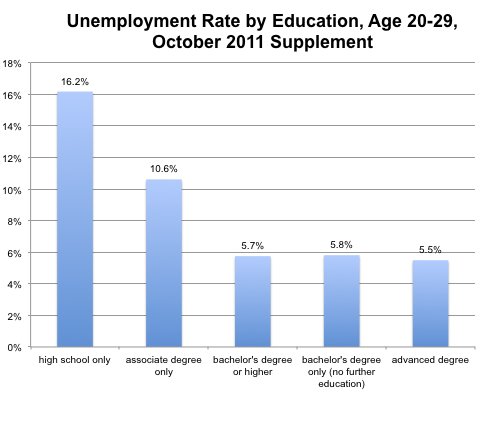
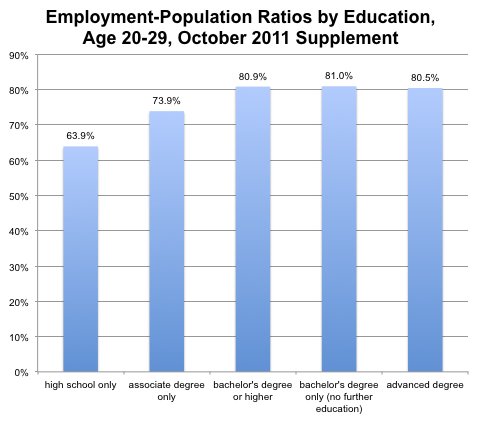
    The Bureau of Labor Statistics latest figures suggest that, all other issues aside, it is financially still a worthy investment. The unemployment rate for college graduates was just 3.7 percent in
    January and that was less than half the rate (8.1 percent) for those with only a
    high school diploma. Here are the stats in chart form:

    Source: Bureau of Labor Statistics. Source: Bureau of Labor Statistics.


    Catherine Rampell, writing in the New York Times blog Economix, notes, "the wage premium for those with a bachelor’s degree compared to those without one is also growing, particularly when you factor in the fact that college-educated people are more likely to be employed at any given time than less educated workers.
    One troubling trend hidden in all of these numbers is that the unemployment rate for those with some college but no degree — 7 percent — is not that much lower than that for people with no college at all."

    Bottom line: It's not only worth the investment, it's worth that extra push to get them to stay the college course.

    Related articles

    Emerging Adults: Words of the wise from dads for their daughters
    Holidays with the Grown Kids: Here today, and then gone.
    College Costs: Are your kids getting your money's worth if you help pay the bill?
    A Case for College: The Unemployment Rate for Bachelor's-Degree Holders Is 3.7 Percent
  • PARENTING GROWN CHILDREN: The children may be grown but we still have our issues.

    I didn't mean to eavesdrop. It couldn't be helped. I was sitting at Panera's having a late morning latte when a trio of friends sat down at a table next to me and started chatting. In my defense, they were using their outside voices–or close to it.

    I started picking up on the conversation when one man, a father, started waxing caustic about his son's request to be treated as a "best friend" rather than as the man's son.

    "I told him," the dad reported to his captive audiences, "I'm your parent. I'll be your best friend when I can come to your house, open the refrigerator and eat anything I want; when I can drink your milk right out of the carton; when I can sleep over anytime I want; when I can drop by without letting you know; when I can leave without closing the door."

    His friends all gave him a fist-bump of an Amen. Given his parade of horribles, I did too, although I did want to turn around and reassure him that his young-adult son was likely to outgrow his juvenile habits; that if he could give his son growing bits of leeway, their relationship would morph from parental disciplinarian to comradely adviser. His son might be chaffing against parental control–isn't that what growing up is all about?–but the dad was fortunate that his son wanted a friendly relationship, even if it was an eventuality. But I kept my comments between me and my latte.

    Related articles

    Food for Thought: A lesson from adolescence that carries over to grown children
    Emerging Adults: Words of the wise from dads for their daughters
  • PARENTING GROWN CHILDREN: The children may be grown but we still have our issues.

    Kids are kids. We bring them up to be independent, accomplished and assertive adults. For our daughters, the leadership–the assertive part–sometimes gets lost in the mix. The new president of Simmons College–my alumnus–posted a piece on Huffington Post: Five tips for dads to pass on to their daughters to help them become leaders.


    Here's a link to the full post. For those who'd like the short, edited version, here 'tis:

     Tip 1: Mistakes are good. Girls should not be
    afraid to make mistakes — or fail; everyone does this and they will
    learn with each mistake how to grow and become better. When the
    opportunity arises, dads, you can talk to your daughter about what she
    learned from her mistakes and how she has grown from them. And you can
    share some of your own failings with her, too.

    Tip 2: Build a sisterhood. Women need mentors just as much as men and these
    relationships are best created when girls are young. Dads
    can encourage their daughters to build strong relationships with other
    girls and to do so in a way that is supportive, not competitive.

    Tip 3: Take up space. For a variety of reasons, girls are afraid to
    physically take up space. (Ask your daughter to sit or stand like a
    girl, and then ask her to reenact how a boys sits or stands. You will
    find the differences — and the space required — remarkable!) If girls
    are not comfortable taking up physical space, this can eventually
    translate into discomfort with their own thoughts, ideas, and opinions
    — some the important building blocks of leadership.

    Tip 4: Science is for girls. Right now, women make up only 25% of the STEM workforce, [STEM is an acronym for the fields of science, technology, engineering and math], which is expected to grow by nearly 20% during the rest of the decade.
    While girls have strong career aspirations, they continue to make
    choices based on gendered messages and often ignore emerging (and highly
    paid) fields such as STEM.  Dads, you can encourage your daughters to try out these
    STEM subjects at an early age. Why not take them to a science museum, or
    encourage them to read about architecture or math?

    Tip 5: Boys can help too: We live in a culture where boys and men are
    encouraged to assert their authority. This oftentimes leads to
    aggressive behavior against girls or women. Dads  can influence behavior by encouraging their sons (and sons'
    friends) to challenge these traits and treat girls and women with the
    respect they deserve.
    Related articles

    Parenting Adult Children: Backing off when we don't like their choice of romantic partner
    Daddy's Sexism May Influence Daughter's Ambitions
    Traditional dads more likely to raise 'girlie girls,' says UBC researcher
  • PARENTING GROWN CHILDREN: The children may be grown but we still have our issues.

    Many of us are called on to help out with the college bills for our emerging adults–and many
    of us agree to pay our children's way, no questions asked or raised. Or we may be asked or want to
    help–after the fact, as those college loans come due.
    Our
    generation has operated under theory that a college education for our children is worth the financial sacrifice–hence the temptation and wide spread practice of helping with tuiltion as well as room and board if we can. Recent news stories have been surfacing that suggest some kids who have to borrow to go to college are questioning whether that higher education is worth encumbering themselves with debt only to find no job in their field when they get out of school. A sobering thought and one that has some reality behind it.
    A recent study that relies on 2008 data reinforces our orginal beliefs. It finds that although college costs more in this country than others, the payoff is bigger. [See Sweden]. This graphic from Planet Money tells a good part of the story.
    .
     

    Notes

    *Data for Japan are from 2007.

    Source: Organisation for Economic
    Co-operation and Development

    Credit: Lam Thuy Vo / NPR

    A few notes:

    The data come from a recently published
    OECD report
    looking at educational data around the world. The cost of education includes
    tuition fees and living costs paid by the student, as well as earnings that
    students forgo by not working while they're in school.

    "Benefits" is the
    difference in lifetime earnings between someone with a high-school degree and
    someone with a college degree.

    For more on the difference in
    earnings between men and women in the U.S., see this study from Indiana
    University.

    Related articles

    Money Matters: The means to help our grown children
    How to Go to College for Less
    Pay for College – Your College Saving Options
    Understanding College Costs
    Low-Cost Higher-Ed – When to start saving for your child's education
    10 Tips for Getting the Most Out of College Financial Aid
  • PARENTING GROWN CHILDREN: The children may be grown but we still have our issues.

    Insights is insight. You take it where you find it. I just finished reading Carl Pickhardt's recent blog on adolescents and parental similarity–how we tend to favor the child who is like us and how the issue rears its head big time as our children go through adolescence.

    What struck me about Pickhardt's column was how it applies as well to our relationship with our children once they have grown into emerging adults and beyond. How much more comfortable we are with adult children who share our values, likes and dislikes, temperaments. When adult children are very different from us–more a throwback to some
    grandparent or one of our parents–we may make them feel they are somehow failing us.

    Pickhardt puts it this way: "In their children, parents
    see reflections of themselves. In their parents, children see models
    for themselves. To the degree that children appear to be like their
    parents, and parents appear how children want to be, a kind of harmony
    based on similarity can rule….

    "In
    human relationships, when it comes to attraction and compatibility,
    perceived similarity can count for a lot. We tend to feel closer to
    others who seem like us. We tend to like those who believe and behave
    like us. We tend to assume other kinds of positive commonality from
    apparent similarities. We even tend to treat strangers better who appear
    similar to us. And we are often drawn to those people who we wish to be
    like."

    All of which can explain a lot when we struggle with our relationship with a child whose values, temperament and outlook on life are just plain not the same as or even similar to ours–or are closer to those of a grandparent, uncle or sister that we happen to not like very much. Not that there's an easy remedy, but a little insight into why there are challenges can't hurt.

    Related articles

    Parenting Adult Children: Backing off when we don't like their choice of romantic partner
    Parenting Adolescents and the Psychology of Similarity
  • PARENTING GROWN CHILDREN: The children may be grown but we still have our issues.

    My friend Lee doesn't understand what is was about her son-in-law that made him attractive to her daughter–even though the marriage is now 15 years old. From the start, Lee didn't see what they would have to talk about–the daughter grew up in an intellectually demanding home; the husband in one where mechanical abilities were prized. She loves to read; he doesn't. She's become a professor of English; he fixes computers. She's slim and attractive; he's pudgy and sloppy. Lee would never have chosen him  or anyone like him–for her daughter. He's totally unlike her daughter's dad–Lee's husband. And maybe that's the irritation and, for her daughter, the attraction. 

    We may not understand our children's choices for romantic partners and life long mates. Their choices may run counter to what we find appealing, important and interesting. But the best thing we can do is what Lee, despite her misgivings, has done: Kept her mouth shut and learned to appreciate what she can about her son in law. 

    I was reminded of my conversations with Lee on this subject–it's one I've had with several other friends as well, friends whose children have hooked up with people the parents consider "beneath" their child or inappropriate in terms of earning power–by a recent Carolyn Hax column.

    A mom complained about her daughter's boyfriend–under-educated, unable to keep a steady job, a lay-about. Her 25-year-old daughter, who owns her own home, has a master's degree and a good job, doesn't seem to have a problem with her boyfriend's lax ways. In fact, she has invited him to move in with her. The mother writes Hax to express her dismay. The boyfriend, she writes, "drives me crazy to the point where I don't speak to him anymore." The issues the mother finds so negative don't seem to faze the daughter. "She doesn't see the problems I see ahead, always being
    the main breadwinner, the lack of financial security, etc."

    Carolyn's answer is a universal one for those who are unhappy with a grown child's choice of mates–especially when it comes to financial potential or other social issues. Unless the boyfriend or girlfriend is abusive (that's a whole other issue), Hax points out that "you squander any right to protest your daughter's choices when you
    bring such clear biases to the table. …If you value your relationship with your
    daughter, then I strongly suggest you throw away your visions of the
    "right" mate for her and start looking harder for what she sees in this
    one — and specifically what he brings to the relationship that isn't in
    paycheck form….Good partners come in more than one shape and size."

    This is not necessarily an easy pill to swallow. It means relying on our grown child's good sense. We can point out "issues" in a neutral kind of way. One couple kept inviting the daughter and the boyfriend they found inappropriate to join them for a lot of family outings–so the daughter would see how poorly he fit in with the family . [The strategy worked.] But expressing contempt, dislike and cutting off communication with the significant other–well, it's not worth the diminished relationship we'll have with our grown child, even if he or she eventually sees the light.

    Related articles

    Carolyn Hax: Mom disapproves of son's live-in girlfriend
    Adult daughter's boyfriend doesn't live up to mom's dreams