PenPenWrites

parenting blog, memoir notes, family punchlines & more

© Penelope Lemov and Parenting Grown Children, 2025. Unauthorized use and/or duplication of this material without express and written permission from this site’s author and/or owner is strictly prohibited. Excerpts and links may be used, provided that full and clear credit is given.

  • PARENTING GROWN CHILDREN: The children may be grown but we still have our issues.

    We've brought up our children to be independent. And many of them have grown up to be just that. Certainly, my friends Pam and Don have two such children. One of them–a daughter–lives in apartment near them. She's married with two small children. Pam and Don play an active part in their daughter's family life–picking the kids up from pre-school two days a week; babysitting on Friday evenings so the young parents can enjoy a date night. That's the kind of support they've been giving since the grandkids were born.

    For the past year, though, support has turned financial as well. Their son-in-law lost his job last year; then their daughter did. Neither held high-paying positions but they were able to make ends meet on the two salaries. Though they are out of work, rent has to paid, food has to be purchased, the pre-schoolers need to be clothed and fed. Pam and Don have stepped up. Don had been a successful businessman and though he is now retired, there is a hefty nest egg in place. They can afford to use some of it to help their daughter and her family. Better now, they reason, then later when their daughter might have no need of a financial legacy.

    They sat down with their daughter and son-in-law, figured out what they needed financially to get by on a no-frills budget, and Pam and Don started supporting them. "These are decent kids. They haven't done anything wrong," Don says.
    "They've worked hard, applied themselves. But they got hit by this
    downturn."

    Both young parents have been job hunting for
    more than a year now and looking into entrepreneurial opportunities. But as the weeks and months tick by, Pam and Don
    are wondering when the joblessness will end, how much longer they can afford to do
    this and what they will do if it gets to the point where the drain on
    their resources will mean a change in their life style and a real threat to their financial well-being.

    These are close friends, and we've gnawed over "the situation" with them and wondered what we would do in their place. They are, of course, fortunate that they can afford to help out right now and probably for another year. But should they suggest their daughter and family move into their home–the daughter's old room is still available as is the guest room/home office. Should they insist that their son-in-law, who spends his day on various aspects of job hunting, take a Starbucks-McDonald's type job just to bring in some cash. Or that their daughter do the same. Pam can't imagine what some of these choices would do to their relationship–the too-closeness of living together; the feeling that they were asking their daughter and SIL to throw in the towel on their future careers. "People talk about tough love," Pam says. "That may be something that applies when your kids are coming out of college, but when they've got a family and they're trying as hard as they can–well, it's different."

    "The groping accident of life" Thomas Wolfe called it. There's so much risk out there–unexpected incidents that happen despite our best intentions and careful precautions. When our grown children are groping along the detritus of an accident, shouldn't we be there for them? Financial counselors will advise you, Don't pauperize yourself helping out your grown children. But sometimes they aren't the only ones in the accident.


    Related articles

    Money Matters: Caught in the web of generosity guilt
    Money Matters: Retire? Not as long as we feel our grown kids need our help
  • PARENTING GROWN CHILDREN: The children may be grown but we still have our issues.

    The first morning of our weekend visit to Uber Son and family, we got up early: Soccer, soccer, soccer was the all-day plan. Paterfamilias was off to the four-game tournament the oldest Grand was playing in. PF was over-the-top excited about watching his grandson on the soccer pitch. All day: Couldn't be a better plan. This is why he wanted to come for a visit.

    I tagged along with my daughter-in-law to watch the youngest grand–she just turned five–at her game. Magnet ball is more like it as all those wee people scrum around the ball, their tiny legs jutting out to try to kick the ball. This was a 9 a.m. game; five-year-olds aren't asked to remain on the pitch for very long. We were back at the house within an hour. But all of a sudden I felt light-headed and nauseated. Heat sick? But it was only 10:00.

    So I crept to my room–the guest room–plopped down on the bed and waiting for it to pass. When I came back downstairs, preparations were being made to get everyone into the van and join 'the guys' in time to see the third and fourth game of the soccer tournament–in 95 degree weather. Yes, it was a hot summery weekend. I apologized for disappearing –especially since a lunch had to be packed, small soccer players needed help removing shin guards, umbrellas and chairs needed to be stowed in the car and other preparations made. Of course, my DIL was on top of things and getting it all done. But one feels an explanation is needed for not being there to help. I told her I had needed a lie-down. She looked concerned but we agreed that, as she put it, I was feeling 'off.'

    What do you do when you're feeling 'off' when you're visiting your grown children? You don't want to disrupt the carefully planned day or miss seeing what you came to see–or cause your children to worry about you or spread your germs should the "off" be something more unpleasant. You're there to help not be helped. So, I soldiered on 'cheerfully' through the soccer games and kept the feeling lousy feeling to myself.

    But then we're back at the house and I am not doing my usual helping out–I am letting my DIL and Uber son cook dinner without so much as a helping hand from me. It feels downright strange to sit there and not bustle around–if not helping in the kitchen or folding laundry then reading to a Grand or doing something else with one or all of the Grands.

    Behind it all was this question: How to be polite and loving but cut the visit short and go home? The fear of being a burden is just below the surface–even though I was hardly feeling really ill. I just longed for my own home and own bed–to pull the covers up and sleep off whatever bug was bugging me. 

    What is it that compels some of us to mount a drive to get away–away from letting our grown children or Grands see us as ill or infirm or even just mildly 'off?' PF and I have been fortunate–to be physically well and able to go bicycle riding with our grown children and our grands, to kick the soccer ball with them and go on hikes–to say nothing of being part of a family touch-football game. Feeling Off reminds me of how lucky I am but how lousy I feel at this moment about being there. Have I put too much in store in my persona as a can-do parent and grandparent. Am i too busy hiding vulnerabilities to enjoy the togetherness just because I feel off? 

    When we finally got home–we did leave early; thunderstorms were predicted for later in the day and the thought of canceled flights tipped me over to an earlier flight–my DIL texted me to see if I was feeling better. I wasn't. But I couldn't bring myself to tell her so. Off is off, but even from a distance, one can't press the burden button–or rather, the fear of being a burden. Why is that?


  • PARENTING GROWN CHILDREN: The children may be grown but we still have our issues.

    The assumption has always been that a college education is the ticket to a good job–a career that will lead to financial independence and middle or upper middle class solidity. Then came 2008 and the great Recession. Kids who graduated from college since then have struggled to gain a foothold in career jobs. Friends whose kids have been entering or trying to enter the workforce since 2008 –well, those kids bear the marks of trauma. They are saving their money more carefully. They are not as free spirited, not as blithe about taking a post-grad year or two off to be a ski bum or bar tend their way across the country as a lark. A serious job outlook calls for a serious mien.

    Today, only 45 percent of young Americans in that age group have a job,
    almost 6 percentage points less than when the recession started in
    December 2007. This trauma has raised the question about whether college–which can cost upwards of $200,000–is worth it. Is it worth it for our kids to take out loans to finance an education or for us to invest our savings–or income–in paying for four years of college? Some studies during the Great Recession and the slow-as-molasses recovery suggested it was a close call. But now there's this.

    Writing on the New York TImes' online Economix, Catherine Rampell notes that "despite all the questions about whether college is worth it or not,
    college graduates have gotten through the recession and lackluster
    recovery with remarkable resilience."

    The unemployment rate for college graduates in April was 3.9
    percent, compared to 7.5 percent for everyone else. Moreover, among all
    segments of workers and their educational attainment, college graduates
    are the only group that has more people employed today than when the
    recession started.

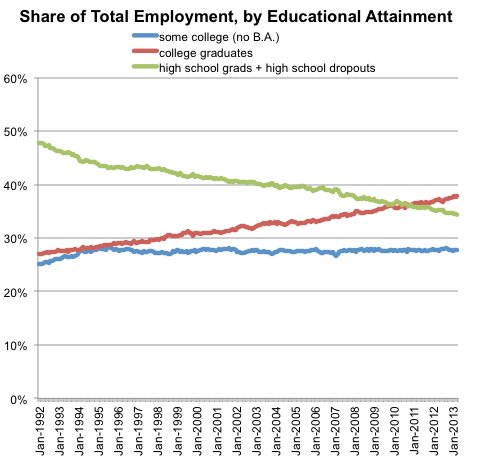
    Here’s the graph the TImes ran to show how employment has changed.

    Source: Bureau of Labor Statistics, via Haver Analytics. Data refer to workers age 25 and older. Source: Bureau of Labor Statistics, via Haver Analytics. Data refer to workers age 25 and older.

    And here's another chart that shows that the number of college-educated workers with jobs has risen by 9.1
    percent since the beginning of the recession. Meanwhile, those with a high school
    diploma and no further education are the near mirror image, with
    employment down 9 percent on net.

    Source: Bureau of Labor Statistics, via Haver Analytics. Data refer to workers age 25 and older. Source: Bureau of Labor Statistics, via Haver Analytics. Data refer to workers age 25 and older.

    "In other words," Rampell writes, "college-educated workers have gobbled up all of the
    net job gains. In fact there are now more employed college graduates
    than there are employed high school graduates and high school dropouts put together." Even young college graduates are finding
    jobs.

    So congratulations to all you college grads out there–my nephew among them. (Yay Ray!)                 
    For them and their parents, it's a brighter picture out there than it was a year or two ago. It was worth the time and effort–and money it took to get that degree. So props to you and an old fashioned pat on the back, too. Now, can you pick up the tab for dinner?

    Related articles

    Re-Nesting: Our grown kids can make their fortune by moving back in with us.
    Emerging Adults: What, me worry? All about a college grad who lacks ambition, to say nothing of a job.
    Unemployment and underemployment rate among college graduates shows the problem isn't lack of skills
    News Flash – Unemployment and underemployment rate among college graduates shows the problem isn't lack of skills
    Economix Blog: Life Is O.K., if You Went to College
    Only 27 percent of college graduates have jobs closely related to their majors
    College Degree Isn't All Its Cracked Up To Be
  • PARENTING GROWN CHILDREN: The children may be grown but we still have our issues.

    The subject is a tricky one: Generosity guilt. If we share the wealth with our grown children in the here and now, do we risk doing them more harm than good? Do we do more harm than good by indulging them–and ourselves–in making life easier for them?


    It's a question we were hashing out with friends where we were house-guests at their home on a lake in a development where the neighbors tend expansive lawns and mind lush rose gardens. Both our friends are recently divorced from their previous spouses. Paying the bills for the lakeside house–its dock, two boats, swimming pool, six bedrooms and huge windows overlooking the lake–is not a problem for either of them. Moreover, they have the money to travel–for pleasure and to visit their grown children who live in various cities throughout the country.

    His three children are recent college grads feeling their way career-wise. He is mum on how he does or doesn't help them. Not so her. She bubbles over with fears that she is overindulging her two daughters who are in their late 20s and early 30s and not living anywhere near the level their parents eventually achieved.

    "I feel guilty," she says of her willingness to give her daughters (both of whom have small children and husbands) money, treats and other indulgences whenever they ask or she feels they need them. "I'm a terrible patsy," she says, while her current partner nods in emphatic agreement. "I'm an endless stream of money for them." At the same time, she confesses to worrying about their psychological health. "I feel guilty that I enable them to be dependent on me. I don't make them stand on their own two feet. It wouldn't hurt them to be self reliant, but it gets complicated."

    One of her daughters has what the mom calls "a black cloud that follows her"–a child needed surgery and there were medical bills over and above insurance; a mistake was made when starting a business and it required cash to rectify. "She's under a lot of stress," says my friend. "I worry about her mental state. If I can relieve her stress by helping her financially, I want to do it." That said, she would like her daughters to distinguish between I need and I want. And to feel less "entitled." When shopping with one of her daughters, the two of them saw necklaces the daughter liked. "She wanted two of them," the mother says, adding that she put her foot down, sort of. "I told her no, just one." 

    Her desire to indulge her children is mixed with few rules over how far the giving should go. The indulgence argument is simple: She has more than enough money to take care of herself. "I get to do everything I want. I have not said 'no' to myself on anything," she says. "Why make my children miserable for lack of money when they're going to get it anyway?"

    Being guilty about being generous is awkward–a conflict in competing values, a feeling of ambivalence about which value should take precedence. This lack of clarity is a point Gretchen Rubin makes in a post on PsychCentral  when she writes about wanting to do one thing but wanting something else that conflicts with it. Two of her examples: I want to eat healthfully; it’s wrong to waste any food. I want leisure time when I come home from work; I want to live in a house that’s clean and well-run. "These days," Rubin writes, "when I’m trying to get myself to pursue some course of
    action, I work hard to make sure I know exactly what I expect from
    myself, and why, and what value I’m choosing to serve."

    Generosity guilt is certainly a push and pull between two values–and which one wins out depends on a whole lot of other values: does a grown child need support because he or she is doing work that helps others but doesn't pay very well? If we value such work, we might chose to enable our child to continue doing it and not suffer the consequence of living within low-income means. A similar reasoning applies to paying college bills or support during graduate school. And if a grandchild needs medical care not covered by insurance, doesn't it make sense to cover those bills that would otherwise stress the parent, our child? On the other hand, two necklaces versus one or even none is a different value.

    There's another way to look at the guilt side of generosity guilt: As a manifestation of helicopter parenting.

    The question Eli Finkel and Grainne Fitzsimons
    pose in a New York Times story,
    "When Helping Hurts" is on point for those of us who help our grown children financially. 
    "How can we help our children achieve their goals without undermining
    their sense of personal accountability and motivation to achieve them?"

    Their answer, based on research they have reviewed, is a pretty
    solid guide to those of us like my friend who worry about the complications of generosity guilt:
    "…Our help has to be responsive to
    the recipient’s circumstances: it must balance their need for support
    with their need for competence. We should restrain our urge to help
    unless the recipient truly needs it, and even then, we should calibrate
    it to complement rather than substitute for the recipient’s efforts."


    Related articles

    Parenting Adult Children: Great gift ideas for grown children
  • PARENTING GROWN CHILDREN: The children may be grown but we still have our issues.

    A friend and i have this conversation almost every time we meet for coffee. We are both still working–me part time, she full time. We have other projects we'd like to attack but work pressures get in the way. We both admit that part of why we continue to toil away is the money. Not that we need the cash to survive or even live well: we've both got adequate retirement nest eggs and pensions. Rather, we like the extra money so we can spend it on our grown kids.

    It is a luxury to be able to do things to help them out–she likes paying the daycare tab for her grandtwins to make sure they are going to the best possible facility. I like sensing a need and providing for it–be it summer camp for a grandchild or a cleaning lady. [My story on Great Gifts for Grown Kids is on nextave.org.] Our paycheck feels like a windfall that we're free to share–no questions asked by our spouses or household partners.

    At least this is what we tell each other–and possibly ourselves. It is, of course, more complicated than that and we're hardly alone in staying on the job past the "normal" retirement year. In 2005, 20 percent of all middle-aged parents were the primary source
    of financial support for a grown child. Now, 27 percent of parents fit
    that description, according to a recent Pew Research report:

    As I've noted in previous posts, the recession/sluggish recovery is part of the reason we are helping out our kids–it has taken a huge toll out of the earnings of young adults. In 2010, according to the U.S. Census, the share of young adults who were employed was
    the lowest it had been since the government started collecting these
    data in 1948. Moreover, from 2007 to 2011 those young adults who were
    employed full time experienced a greater drop in average weekly earnings
    than any other age group.

    So we soldier on. But supporting our kids–whether as an indulgence or to carry them through hard time–is only part of the reason we're still on the job. A lot of us are in better health than our counterparts a couple of decades earlier–and we may live longer. In which case, we like the idea of piling up the resources–or letting the piled-up resources lie there untouched while we use the still-on-the-job earnings for spending sprees. We don't want to outlive our nest eggs and be a burden to those whose loads we've just helped lighten. Or is that part of the indulgence factor? 


    Related articles

    Money Matters: The means to help our grown children
    College Costs: Are your kids getting your money's worth if you help pay the bill?
    More Americans Support Aging Parents – And Grown Kids
    Middle-Aged Adults "Sandwiched" Between Aging Parents and Kids
    More middle-aged adults care for kids and aging parents
    Parenting Adult Children: Great gift ideas for grown children
  • PARENTING GROWN CHILDREN: The children may be grown but we still have our issues.

    There's a lot of griping about us out there. Grown children writing in to the Carolyn Hax's, Ask Amy's and Social Q's of this world, whining about the way we behave or the unkind or ungracious things we say. Sometimes, we may mean one thing, but it gets taken another way. The world is full of mis-cues.

     I was struck by this one, described by a grown son complaining about the way his mother talks to his wife. The issue: The Mother keeps making critical remarks about the son's wife, who is a pediatrician and the mother of small children. The Mother is critical about such things as the Halloween costumes (They're store bought!), help being hired to clean the house ("It is a real shame that people can't take the time to clean their own home anymore.") and dinners not made from scratch ("It isn't a homemade dinner if the chicken came precooked from a store.")

    Who would like to have those kinds of comments rain down on your head when you're working full time and raising children? Or even if you're not working outside the home. Carolyn Hax suggests the son have a conversation with his Mother that lets her know that when she makes these comments she denigrates his life choices and that when she compares his family life to the one she created as a young mother, she's "entering cats in a dog show." Hax also points out that the Mom might be defensive about the way she lived her life–that she may feel like an anachronism–and may need reassurance.

    All true and all helpful. I see an additional point. Many of us may take to the snark attack when we feel left out–unconsulted, tuned out, useless. There are better ways to work out those feelings. I'm not sure what they are–but giving in to attacks isn't helpful. Nonetheless, the Mother has some of my sympathy. We're there but we're not; we understand the pressure of their family-raising lives but good luck getting that understanding across. We're not as out-of-it as they may think. But when we impose our own Good Housekeeping Rules–well, see notes to self [in the column to the left]: Our ideas about how to do things "the right way"are better left unspoken. Who really cares who made the Halloween costume, anyway? My kids had to pull together their own looks. As for the store-rotisseried chicken–we'd starve at my house if those were eliminated. My mother, however, would be aghast. And she would probably let me know it. Cue up another mis-cue.

    Related articles

    Parenting Adult Children: Great gift ideas for grown children
    Parenting Grown Children: Praise, criticism and the relationship with our relations
    Carolyn Hax: Grandmas share their grandchild
    Mother-in-law meddles in working parents' lives
  • PARENTING GROWN CHILDREN: The children may be grown but we still have our issues.

    I had lunch with a friend  who was worried sick about her
    college-senior son. Her complaint: He is directionless and unable to take action to
    get a job. Not only hasn't he signed up with his college's job-search office or applied to opportunities his mother has suggested or unearthed. He hasn't even written a resume–no less let his parents review it for him.


    His post-grad plans, such as they are, include living in an apartment with his current roommate–a chemical engineering major–who landed a high-paying job with a corporation. How will he pay the rent? his mother asked. "He told me his roommate might help him out for a few months," the mom says, clucking her tongue and getting angry all over again.

    It's scary. College days–and the comparative irresponsibility of those years–are coming to an end. Reality needs to be faced. When she was his age, this mom says, "I knew no help would be coming from my parents. I was on my own. You can bet I had a job by the time I graduated."

    These years when our
    children are "emerging adults" are tricky ones. A lot of "tough love" v. "helping hand" decisions are suddenly upon us. Job  hunting is no one's idea of a good time. My friends older son, who graduated from a top liberal arts college, is still struggling to find a "career" job. He's taking himself off to graduate school next year–he sees that as the only way to get ahead in his field. His younger brother can't help but know how tough it's going to be out there. A good athlete and student, he seems almost unnerved by having to try his wings in an arena where he doesn't know if he'll be "good" or not. 

    Mother and son are barely speaking at this point. The dad's job has
    taken him out of the country for long stretches so she feels she is on
    her own in guiding this talented but un-ambitious son.

    I try to
    reassure her that he will grow out of his lackadaisical style, that he will figure things out.  [I've written this post on the outgrowing phenomenon.] That's what a growing body of
    literature suggests will happen. For my friend in the eye of the storm, it's hard to keep any perspective about eventual growth and growing up. Not when so many of her son's friends have done so already.


    Related articles

    Emerging Adults: Another view of that hard-to-find-a-job issue
    Re-Nesting: Our grown kids can make their fortune by moving back in with us.
    4 Myths We Tell New Grads
    No big boost in jobs for this year's grads
    Ask the Headhunter: How New Grads Can Get in the Door for a Job Interview
  • PARENTING GROWN CHILDREN: The children may be grown but we still have our issues.

    I was obsessed with the Boston Marathon-Watertown attacks. Followed the hour-to-hour headlines the first few days. When the action moved to Watertown on Thursday night and lock-down Friday, that changed. I became a live-action addict as police cars were spotted moving toward some sort of end game. Me and millions of others.

    I had an additional reason for my addiction: A grown child–Alpha daughter and her family–lives on a street that's on the Watertown border.  Her emails were, as Uber son put it on his Facebook posting, "like a postcard from the edge of civilization."

    The first one on Friday morning: "A minute ago, Tao started barking her alarm bark,
    and we looked out the window … to see a lone man crossing Mt. Auburn St.
    (Belmont Ave.) wearing a hoodie and a baseball cap. … Kind of weird. Weird
    that anyone would wear that right now. We decided he was bigger than the fugitive.
    However Tao is on alert by the window. Our neighbor, who just graduated from Rindge, was
    on the wrestling team with the guy (the younger brother) and said he was really
    nice, everybody liked him. Madness…"

    Her brother called her to say that if she could find a way to do it, she
    should bundle the family in the car and drive to his house–2.5 hours
    to the west. She couldn't, of course. A few hours later on Facebook she posted this:

    "Police helicopter hovering over the house &
    police lining the street at the end of the block, swat team in church — we
    live on the Watertown line. Not sure when dog walking will be possible."

    I was filled with nervous energy all day. There she was in a house that, it turned out, was nine streets away from the boat where Dzhokhar was shocked and awed out of his hiding. The town diner where swat teams assembled and police hung out–an easy walk from her house, one we take all the time when we visit.

    We were all flooded with relief when the end finally came. For the country, for Boston, for Watertown–and on a more personal level, for my own little family. When our children are in the slightest bit of danger, our tiger-bear fur ruffles up. But the cubs are grown up, living their lives, managing this difficult experience without our help. It's their experience, not ours. They were under seige, not us.

    And yet I still feel the need to vent, to bore friends with the "close call," such as it was. To show them the maps and point out where Alpha daughter lives, where the shootout was, where the boat was housed in a backyard–so close to her house and yet far enough away. I don't want to inflict my worries on my daughter–even in hindsight. But that doesn't make them go away. So I'm unloading on friends and on my blog. Does no harm. My silver lining: how bro and sis reached out to each other in a time of stress–and not with a heavy hand.

    There's at least one person I know who shares my unease. A co-worker says his daughter, a graduate student in Boston, was
    walking from Brookline toward the Marathon finish line when the bombs went off. "She was too far off to see anything, but it was a close call nonetheless," he tells me. I understand. So far and yet so near.


    Related articles

    Lockdown in Watertown, Mass.: What do I tell my kids?
    PHOTOS: Surreal Images of SWAT Teams Combing Watertown
    Watertown man had front-row seat to shootout with Boston Marathon bomb suspects
  • PARENTING GROWN CHILDREN: The children may be grown but we still have our issues.

    We've all read or heard stories–or experienced the real thing–about college grads (or even older kids) moving back home. Thank you Great Recession and the Oh-So-Slow Recovery.

    But that's only part of the re-nesting story. As I've written in a previous post, having our adult children live on their own after college is a socio-economic and cultural phenomenon. In many other countries (first world and otherwise), it's accepted as the norm that the kids will live at home until they marry. And for good reason: When they have a job, they can save money for their future connubial adventure or to invest in an entrepreneurial dream.

                All of this is the long way around reporting about a formula I came across recently: How much a stay with mom and dad is worth. The logarithm factors in the usual stuff–rent and food, as well as the other perks of living at home, such as having an Internet connection and cellphone paid by the parents and having laundry done by the host (usually, the hostess.)The findings? I'll let The Calculator tell it:

    "I wish I’d lived in my parents’ basement the last four years. I’d be $85,000 richer. That would put me in down payment [on a condo] territory already…. Instead, I wasted all my money on rent, food, and TV."

    Our hero kept a detailed spreadsheet of everything he spent in his four post-college-grad years living at home and used that journal to create, as he puts it, "a breakdown of the money I washed away."


    Want to know what you're host-home is worth to your grown kid? You can go to the “living with your parents
    calculator and plug in rent and other expenses (or use The Calculator's estimates of his spending habits) and see how much your grown child would save in four years of living in his or her old room at your house. Hint: The Calculator assumes you'll pay for car insurance and put him or her on your health insurance and that the money saved from living at home would be invested to earn a return.

    Bottom line: Re-nesting is worth a sizable nest egg for them. For us, it's a less monetary formula: A chance to experience quality and quantity time with them. Fortune and fortunate tied up in one small bedroom. 

    Related articles

    Emerging Adults: What to do with the anger when our kids make us mad
    Money Matters: When we help out our grown kids, whose hand pulls the purse strings?
    Qualms About Leaving Mom's Nest: Starting Life As An Adult
  • PARENTING GROWN CHILDREN: The children may be grown but we still have our issues.

    In the annals of family gift-giving, I scored a home run recently: I
    gave my daughter—a grown child who already has 1 husband, 1 child, 1 dog, 1
    highly competitive job and 1 small house — the gift of once-a-fortnight housecleaning
    service.

     Not that I barged in with the present virtually wrapped in
    cheery gift paper.  I was, in fact, wary
    of presenting her with a gift that she might take as criticism of her and her
    spouse’s housekeeping skills. So I asked before I gave and I framed it this
    way: Given all the demands on her time, I didn’t see why she should use
    precious energy vacuuming, dusting and scouring her house when help was
    available—help that I could make happen.  

    Reader, she did not take umbrage—she was thrilled. She had
    been thinking about it herself and trying to figure out a way to stretch her
    tight budget to cover the cost.

    Score
    one for parents looking for gifts that can delight as well as help their grown
    children—whether that child is struggling financially or could use the boost of
    a little indulgence.

    I stumbled into my unusual present, but others have
    given gift-giving more thought and come up with  presents that their grown children have really appreciated. The seven brilliant ideas of others are listed in my article on NextAvenue, the PBS Web site for baby boomers–everything the 50+ set is dealing with.

    You can check them out there: "8 Gifts Your Grown Children Will Truly Appreciate." They range from paying off some of their debts–as in, a year's worth of monthly car payments–to providing meals when a new-born baby arrives to opening a Roth IRA retirement account for them.

    Go forth and give non-gadgets.

    Related articles

    Grandparenting: Finding a place in the busy lives of our grown children and their children