PenPenWrites

parenting blog, memoir notes, family punchlines & more

© Penelope Lemov and Parenting Grown Children, 2025. Unauthorized use and/or duplication of this material without express and written permission from this site’s author and/or owner is strictly prohibited. Excerpts and links may be used, provided that full and clear credit is given.

  • PARENTING GROWN CHILDREN: The children may be grown but we still have our issues.

    Then

    Womenwork 1960 v2

    And nowWomentech2015 v2

    We shouldn't compare. But a recent Pew Foundation study gives us the ammunition to do it. It's our Silent and Early Boomers Generation (born in the 1940s and 50s) vs their Millennials (born in the 90s and 2000s). We're 50 years apart in terms of entering those young-adult years. So how's it going for them versus how it went for us?

    Here are some of the major differences the study catalogues:

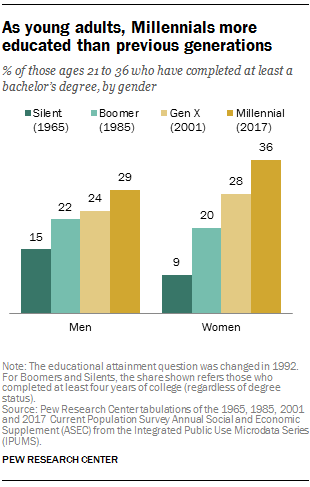
    Today’s young adults are much better educated than our generation was.  The findings in chart form:

    During the young adult years, they are more likely to be working (71 percent) than we were (58 percent).  This shift to more women in the workplace ratcheted up in the mid 1980s, when Boomers were young.

    They're marrying later than we did. In 1965, the typical American woman first married at age 21 and the typical man wed at 23. By 2017, first-marriage ages hit 27 for women and 29.5 for men.

    In our day, men were more than 10 times more likely to be veterans than young men today. Millennials can thank the all-volunteer army for that. Men of our generation came of age during the Korean War and its aftermath.

    More of them are living in cities than we did. In 1965, around two-thirds of young adults lived in a metropolitan area. Today, nine-in-ten live in metro areas.

  • PARENTING GROWN CHILDREN: The children may be grown but we still have our issues.

    Philipgalanes

    The particulars don't matter. The point Philip Galanes makes is, "Don't get between your grown children and their children." Our beliefs and accumulated wisdom may run counter to the parents' but unless the child is in grave danger, our role is to stay out of it.

    That said, here are the particulars on what Galanes and his Social Qs suggested to a grandmother, an atheist who wanted to discuss "belief in a fictional diety" with a young grandchild whose parents have enrolled her in a parochial school.

    "If you are concerned that your granddaughter's worldview is too narrow, head straight to the parents. Your daughter sounds open-minded. But you've had your turn raising children: now it's theirs. (And remember how it felt when parents and in-laws offered unsolicited advice to you?) Your granddaughter will probably appreciate hearing your philosophy when she's older. For now, wait for her to ask you about it."

  • PARENTING GROWN CHILDREN: The children may be grown but we still have our issues.

    Cats n big cat

     In the piles of stuff we leave behind, who can say what our children will consider a treasure: the Rosenthal dinnerware for 12 (minor chip on one dinner plate) or the well-worn cereal bowls that were filled with Cheerios every morning while the kids sat elbow to elbow with their Dad and talked about stuff.

    We narrowed down our legacy of give-aways when we rightsized our way from suburban house (43 years of family living) to an urban apartment (minimal storage space). We offered our grown kids a pick of the pre-move litter. They wanted no cut glass vases or silverplate candlelabras–items deeded us by our parents and hauled out for special occasions.  They opted for stuff with personal or sentimental value–the piano being Exhibit One and their grandmother's hand-painted tea cups another.

    We moved with our favorite pieces of furniture, works of art and two bins of family memorablia. So there is still some sorting out our kids will have to do when we're no longer in charge. (Hopefully no fights will break out over who gets my collection of whimsical cats. See above)

    Even though we've slimmed down, we should make a list of the stuff we have that our kids will have to divide up among themselves or give away. Like many of our friends, we keep putting it off. There's the temptation to say, 'Let the kids figure that out.'

    "Wrong" is what the financial/estate planning experts say. When we pass away, it's an emotional experience for our kids. The 'stuff" we leave behind may hit a deep sentimental note for one of them or–and here's the problem–one item may mean a lot to all of them. The sentimental stuff turns out to be the more contentious than the "valuables" and has the potential to create nasty divisions among the inheritees.

     When we write our wills, it's relatively simple to divide the monetary stuff–the bank accounts, stocks and bonds, real estate holdings. A simple formula will do, as in: three kids, divide three ways. But the other stuff–the low- or no-value things like needlepoint pillows, rocking chair, cat statuettes: There isn't an algorithm for dividing it up fairly. If son A gets the vase we picked up in Greece, does daughter B get the pasta bowl from Tuscany? Is there something so evocative of childhood–the cookie jar, the kitchen table–that all the grown kids in the family want it?

    Some families do the picking and choosing with their children. The Washington Post ran a story about parents who laid out all the tangible items, gathered their grown children together and gave them each $2,000 worth of monopoly money. The kids could then bid on what they would want–when the time came. Says a son, who admits he got into a bidding war with his brother over a  living room chair, "I have had friends fight with siblings over their parents' stuff–not the expensive stuff, but odds and ends that each child wanted." His family, the son says, "avoided this problem brilliantly. Dad was the auctioneer and mom recorded the results."

    Friends of ours whose basements and attics are packed with photos, memorablia, two generations of  dishes and artwork,  have taken various non-auction approaches to parceling out the eventual disposition of their stuff.

    One is doing it with stickers: Yellow dots under the chairs, rugs and lamps they want their daughter to have; red sticker dots for their son. They hope the stickers stay stuck and that the kids find the distribution fair. As to the accumulated stuff in the basement storage spaces, they're leaving that to their son's and daughter's good will.

    Another friend is making a list and using past observations to figure out who should get what. They have seen their oldest son eye the wooden statute in the dining room and their youngest son admire the  landscape painting in the family room. They want their daughter to have the jewelry–the rings, bangles and necklaces handed down by great-grandmothers and grandmothers. There is one  caveat: the  eldest son's daughter (and the first grandchild who's now a teenager) gets an early pick from the jewelry collection.

    There may not be a "best way" here. An auction would be fun, but even a straightforward list beats having our kids duke it out when we're gone.


  • PARENTING GROWN CHILDREN: The children may be grown but we still have our issues.

    Feed at birdhouse
    The pressure on Chinese parents to help their Millennial-aged children buy a home is a jaw-dropper.  The Chinese one-family policy plus the urbanization of the economy  is creating a generation of Little Emperors  that have high expectations for how much their parents will do for them in terms of housing.  With housing tight in urban areas and unaffordable at the salaries the Little Emperors are earning, Chinese millennials are looking to their parents to help with the down payment on a house as well as a hefty assist with the mortgage payments.

    It's a familiar story–at least the housing part of it.

    In Australia, where there's a housing crunch too, a study of 2017 home purchases found that more than half–55 percent–of first-home buyers got a financial boost from their parents. It's quite a leap for the land down under. In 2010, only 3.3 percent of first-time buyers got help from mom and dad.

    Here in the U.S., the pressure also starts at home. According to a recent analysis of census data by Zillow, in 2005 roughly 14 percent of millennials (ages 24 to 36) lived at home with mom and dad; today, it's nearly 23 percent. They're there for a variety of reasons but chief among them is the cost of housing in urban areas, which is outpacing wages.

    Both millennials and their parents would like to see the youngsters move out and into a home of their own, and parents are helping make that happen.  A 2018 survey by the  National Association of Realtors found that, among homebuyers who made a down payment, 23 percent of those 37 and younger had the wherewithal of a gift and 6 percent a loan from family or friends — the highest proportion for either type of assistance among all age groups.

    Feels like help with a down payment is becoming a universal language of love–or for parents who can afford it, a loving necessity.


  • PARENTING GROWN CHILDREN: The children may be grown but we still have our issues.

    Job search

    You may find this hard to believe– I did. But there are those among us who are taking a few dubious extra steps in helping our kids find a job. Where we used to assist by fine tuning a resume or buying them  interview clothes, a few of us are now marching to the job interview with our kids or even sitting in on that interview.

    No wonder Alison Green says that some of us "intervene shamelessly in our children's professional lives." Green, who runs a website called Ask a Manager and Slate's Direct Report,usually sticks to general workplace advice aimed at work-seekers and workers. But she's also had some things to say about the "shameless" stuff.

    When it comes to advice, the most common type of parent misstep falls under the umbrella of gumption. It’s the idea that to get a job, you need to impress an employer with your persistence and resourcefulness, often by doing things that in other contexts would be considered aggressive or even creepy.

    Green's real-life example: A parent advising a recent college grad to make the rounds of offices and drop off a resume–or even insist on seeing the hiring manager.

    Green points out how totally out of date that idea is:

    For the record, while the idea of getting a job by “pounding the pavement” remains deeply popular among parents of twenty- and thirty- somethings, it doesn’t work in most fields these days, where employers generally want candidates to apply online and not show up with a résumé without an appointment for an interview.

    Green also points to a whole category of bad parental advice "rooted in the sweet but misguided faith that employers will surely be blown away by how impressive their children are." A college adviser told Green that a father, who accompanied his daughter to the meeting with the adviser, accused the adviser of sabotaging his daughter's job search. He thought entry-level positions were beneath his daughter–even though she was 21 with no work or volunteer experience at all–and insisted the daughter apply for mid-level positions because “that shows initiative and drive.”

    To Green, the most troubling issue is that some parents haven’t accepted that their adult children can–and should–manage their professional lives themselves. Even when their child lands a job, some parents, she reports, call an employer and ask why their child was not given a promotion or raise or singled out for praise.

    These parents are doing their kids no favors. Not every employer will bother to ask, “Does your kid know that you’re calling us?” and instead will assume that the kid knows about and has condoned the parent’s interference … which will get them tagged as immature and out of touch with professional norms at best and difficult at worst.

    Green's advice to children caught up in these forms of helicopter-parent advice is to limit how much information they give their parents so that the parents will have fewer opportunities to interfere.

    Not exactly what we're aiming for when our kids are going through the grueling job of finding a job.


  • PARENTING GROWN CHILDREN: The children may be grown but we still have our issues.

    Sidebar

    As we age and head toward or are in retirement from our day-to-day jobs, do we dwell on the past too much? It's a question I've asked myself, in part because it can be a drag on our lives and on our grown kids and grandkids. It can be charming to refer back, to say, "When I was your age…." but it's only charming if it's a once-in-a-while thing.

    Yes, it's important as I've written in previous posts, to leave a legacy–to let our grown kids and grandkids know who we are, what we've done with our lives, what our values are.  We don't have to wait till we're no longer around to let our Wills or "last thoughts" memos let them know what we've found meaningful in life and how we found it.

    But it's also important to be moving forward–whatever age we are. As financial writer Carl Richards noted in a recent column,  he could feel the energy change in the room when he got together with two friends from his high school days. After they reminisced for a bit, the conversation shifted from the past to the future.

    Here's how he described the moment:

    It started simply enough, with one of us asking, “If we were having tea three years from now in this exact same place, sitting in these exact same chairs, what would need to happen for each of us to be happy with those three years?”

    Talking about high school was great, but this was so much better. You could immediately feel energy and confidence enter the room as we started scheming.

    Turns out, we are not the first people to entertain this question. Dan Sullivan wrote an entire book about it. In “The Dan Sullivan Question,” he talks about designing a question to help people make their future seem bigger than their past. “The moment your past becomes bigger than your future, you die,” he said, when I eventually heard him speaking on a podcast.

    I read that and asked myself, does that apply to me and my relationship with my grown children? Am I able to bring something new and energizing to my conversations with them? Do I have something interesting to say about what I'm doing in the here and now or am planning to do? How much more vital I feel when the conversation is not just about what they're up to (what a burden on them) or what I thought or did 20 years ago.

    In her search for a formula for happiness, happiness guru Gretchen Rubin found Aha! moment in a line from William Yeats:

    “Happiness is neither virtue nor pleasure nor this thing nor that, but simply growth. We are happy when we are growing.”

    Here's what Gretchen had to say about that moment of discovery:

    That word, "growing," snapped everything into place. Of course. Growth. Growth helps explain the happiness brought by children, by gardens, by pay raises, by stamp collections, by training for a marathon, or learning to use PhotoShop, or cooking your way through a Julia Childs cookbook.

    All of which is a long way of saying, it made me realize that we who are of a certain age and at a certain stage in life need to keep on truckin'–be it a project to work on, a class to go to, a trip to take. Whatever it is, I find the forward movement not only makes me happy but helps me bring energy to my conversations with my grown- and grandkids. It helps me makes sure I'm maintaining a life independent of theirs.

    That is what we want, right?

  • PARENTING GROWN CHILDREN: The children may be grown but we still have our issues.

    Philipgalanes
    The mother finds her son's latest love interest "a wonderful woman: kind, hard-working, self-made." So far so good. In a letter to Philip Galanes at Social Qs she writes that she would be pleased if her son married her. The mother's only problem: the wonderful woman practices a dining custom of her culture where "people lick their knives during meals." Looking ahead, the mother who may be future mother-in-law to this "kind, hardworking" woman is worried that any children her son and this woman have will pick up the knife licking habit and that the extended family will hold her grandchildren up to ridicule. How should she broach the knife-licking habit with her possible daughter-in-law.

    Knife licking may not be something any of us are faced with, but we all may have had concerns about an unfortunate habit–or culturally based idiosyncrasy–that we would like our daughter- or son-in-law or our child's life partner to curb. So what does Philip Galanes say we can do about such matters?

    "If she and your son marry and produce offspring, you will be entitled to express grandparental concern about sharp objects in tiny mouths. But that's a problem for a far-off day. You've done very well to keep quiet about cutlery to date, and I encourage you to keep it up. A supportive mother-in-law trumps a Westernizing etiquette coach every day of the week."


  • PARENTING GROWN CHILDREN: The children may be grown but we still have our issues.

    Thinker
    It's always a thrill to get together with our grown kids and their kids, to be absorbed, however temporarily, into their family routine and culture. For those of us whose grown children live beyond the reach of a casual Sunday dinner, the visits in and of themselves are gifts. So, when something extraordinary or insightful happens, the gift moves into the treasure category.

    What could be more of a treasure than to hear our high-school aged grand kids use their critical faculties in ways that open our eyes to their understanding of the world and how it works.

    We had such a treasure when our son and his family were visiting us for a weekend this summer. The reason for the visit: a soccer tournament in which the oldest grandchild's team was participating. Weather being weather and thunderstorms being a tournament buzz kill, we ended up sitting around our living room amid the wreckage of cancelled games.

    Our son had in hand 16 essays from finalists for a small stipend for their freshmen year in college. He read them aloud to get our critical input, with our grandkids as additional in-house critics.

    We adults brought to our comments on the short essays, which were written by kids who were graduating from inner-city high schools and who had lived in and with poverty.  We were going to advise as to which three finalists should win the stipend. To the task, we adults brought the wisdom of our life experiences but also our unconscious biases. Our two teenage grands are closer to the ground–closer in age to the kids writing the essays about their life experiences and to teen life in general. They were much more understanding of some of the shortcomings in the essays, and surprisingly harsher on others. One exceptionally well-crafted essay they suspected of leaning on a formula of what one was supposed to say. A less elegant but emotionally direct essay they saw as an authentic reflection of obstacles this youngster had to overcome and where he hoped to go in life–not necessarily to a place that we, as adults, saw as aspirational enough.

    I was struck by the seriousness of purpose our grands applied to the task and their ability to understand the essayists at a level where we as adults had to struggle.

    The lesson I took away from this: As grandchildren grow into teens and young adults they have points of view that add to our understanding of the world, though we usually think it's the other way around.


  • PARENTING GROWN CHILDREN: The children may be grown but we still have our issues.

    Malia-obama-

    I know, I know: This is not what Obama's Sept 7 speech was all about. But hear me out: Those of us who are parents of adult children–especially young adult children leaving the nest and going off to college–can't help but notice that in his opening remarks he took note of parental pain and shared his with us.

    Here's what he had to say at the University of Illinois 

    … now that I have a daughter in college, I can tell all of the students here, your parents suffer. They cry privately. It is brutal. So please call. Send a text. We need to hear from you, just a little something.

  • PARENTING GROWN CHILDREN: The children may be grown but we still have our issues.

      VGogh reading book

    Given the teen preference for texting, an email this summer from a granddaughter in Massachusetts to me in Maryland was a surprise. The subject line even more intriguing: Is this You? it read. The body of the email held links to articles I'd written. A click and I was reading stories I'd penned for various newspapers and magazines–one from 1978; another, 1983.

    Why was my 15-year-old granddaughter sending me links to long-ago and far-away articles? Why, in short, had she Googled me?

    The prosaic answer was this: She was applying to a summer program in journalism and had to write an essay about her interest in communications and the media. One paragraph was about her grandmother (that's me) being a journalist, and she evidently checked that out–looked for proof–by calling up some of my stories.

    I am still a journalist–part-time now. But when my granddaughter was born and until she turned 11 I was a full time editor at a national magazine, having worked my way up from staff writer. 

    That being so, the question nags at me: Why did she have to Google me to find out about my standing as a journalist? When I asked the grandfather (aka my husband and a lawyer who once worked for the U.S. Congress) what he thought, he reminisced about all the legal and political issues he had shared with this granddaughter once she was old- or interested-enough to understand.

    I had not. My granddaughter knew I worked but I never talked to her about my career. When I went to visit her or she came here, I kept my grandparenting focused on the quotidian. I was observing, getting a feel for what she cared about, thought about, was interested in and how I could add background, anecdotes or information to her concerns. I didn't bring my world to her.

    I must have shared a funny story or two–in search of a story we journalists are a riot. Sometimes. But I hadn't discussed what I wrote about or the many climbs and plateaus, hurdles and high points I faced–from my first job answering letters to the editor at Time Inc to ending up as an editor and  columnist on municipal finance at Governing Magazine.

    "She absorbed some of it by looking around," my daughter said when I brought up the missed opportunities. My home-office, which doubled as my granddaughter's bedroom when she came to visit, had various memorabilia hung on the wall for my own viewing pleasure–a plaque for a journalism award, a "joke" Washingtonian cover with my face on it.

    If I ever finish the memoir I'm writing about my years at Time Inc (an aggressively sexist time in the work place in general, in journalism in particular and at Time especially), my children and grandchildren will know more about what this grannie did with her life. It's an important part of the legacy we leave. The life choices we made reflect our values and give our children and grandchildren at least one road map–hopefully among many others–about what paths there are in life and ways to deal with some of the stickier issues those paths can throw at you.

    The written version is where I'm heading in terms of explaining myself and my world to my grown children (it's astonishing what they don't know) and grandchildren. In the meantime, the idea that my granddaughter had to Google me to learn about my career is a reminder (note to self) to share the past–the good stories, fun anecdotes, and rich experiences–with our family in the here and now. It's an on-going story, even if we capture it in a final written or video'd form some time down the road.