PenPenWrites

parenting blog, memoir notes, family punchlines & more

© Penelope Lemov and Parenting Grown Children, 2025. Unauthorized use and/or duplication of this material without express and written permission from this site’s author and/or owner is strictly prohibited. Excerpts and links may be used, provided that full and clear credit is given.

© Penelope Lemov and Parenting Grown Children, 2025. Unauthorized use and/or duplication of this material without express and written permission from this site’s author and/or owner is strictly prohibited. Excerpts and links may be used, provided that full and clear credit is given.

Then

Womenwork 1960 v2

And nowWomentech2015 v2

We shouldn't compare. But a recent Pew Foundation study gives us the ammunition to do it. It's our Silent and Early Boomers Generation (born in the 1940s and 50s) vs their Millennials (born in the 90s and 2000s). We're 50 years apart in terms of entering those young-adult years. So how's it going for them versus how it went for us?

Here are some of the major differences the study catalogues:

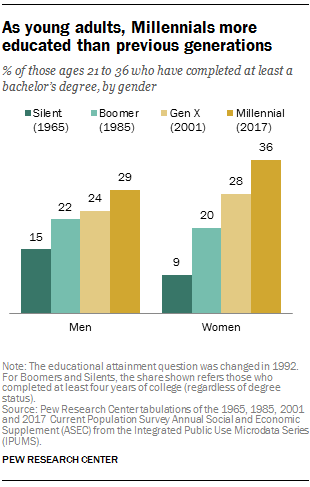
Today’s young adults are much better educated than our generation was.  The findings in chart form:
During the young adult years, they are more likely to be working (71 percent) than we were (58 percent).  This shift to more women in the workplace ratcheted up in the mid 1980s, when Boomers were young.

They're marrying later than we did. In 1965, the typical American woman first married at age 21 and the typical man wed at 23. By 2017, first-marriage ages hit 27 for women and 29.5 for men.

In our day, men were more than 10 times more likely to be veterans than young men today. Millennials can thank the all-volunteer army for that. Men of our generation came of age during the Korean War and its aftermath.

More of them are living in cities than we did. In 1965, around two-thirds of young adults lived in a metropolitan area. Today, nine-in-ten live in metro areas.

Posted in

2 responses to “Generational Divide: Life styles of our grandkids versus our generation”

  1. Christie Hawkes Avatar

    Very interesting. Times have changed. I’ll be interested to see what my young grandchildren are doing in the next 10 years.

    Like

  2. penny Avatar

    This just in since I posted: fter bottoming out in 2011, Incomes are rising for American households – and those headed by a Millennial (someone age 22 to 37) now earn more than young adult households did at nearly any time in the past 50 years, according to a Pew Research Center analysis of new census data.

    Like

Leave a comment