The assumption has always been that a college education is the ticket to a good job–a career that will lead to financial independence and middle or upper middle class solidity. Then came 2008 and the great Recession. Kids who graduated from college since then have struggled to gain a foothold in career jobs. Friends whose kids have been entering or trying to enter the workforce since 2008 –well, those kids bear the marks of trauma. They are saving their money more carefully. They are not as free spirited, not as blithe about taking a post-grad year or two off to be a ski bum or bar tend their way across the country as a lark. A serious job outlook calls for a serious mien.
Today, only 45 percent of young Americans in that age group have a job,
almost 6 percentage points less than when the recession started in
December 2007. This trauma has raised the question about whether college–which can cost upwards of $200,000–is worth it. Is it worth it for our kids to take out loans to finance an education or for us to invest our savings–or income–in paying for four years of college? Some studies during the Great Recession and the slow-as-molasses recovery suggested it was a close call. But now there's this.
Writing on the New York TImes' online Economix, Catherine Rampell notes that "despite all the questions about whether college is worth it or not,
college graduates have gotten through the recession and lackluster
recovery with remarkable resilience."
The unemployment rate for college graduates in April was 3.9
percent, compared to 7.5 percent for everyone else. Moreover, among all
segments of workers and their educational attainment, college graduates
are the only group that has more people employed today than when the
recession started.
Here’s the graph the TImes ran to show how employment has changed.
 Source: Bureau of Labor Statistics, via Haver Analytics. Data refer to workers age 25 and older.
And here's another chart that shows that the number of college-educated workers with jobs has risen by 9.1
percent since the beginning of the recession. Meanwhile, those with a high school
diploma and no further education are the near mirror image, with
employment down 9 percent on net.
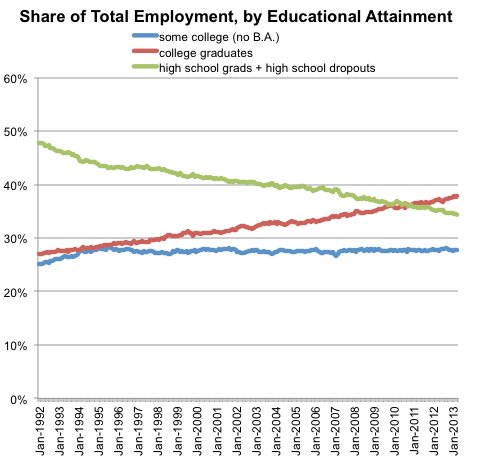 Source: Bureau of Labor Statistics, via Haver Analytics. Data refer to workers age 25 and older.
"In other words," Rampell writes, "college-educated workers have gobbled up all of the
net job gains. In fact there are now more employed college graduates
than there are employed high school graduates and high school dropouts put together." Even young college graduates are finding
jobs.
Related articles


 PenPenWrites
Leave a comment