When Carol heard from a friend about a job that suited her son, she got in touch with the 22-year-old immediately. He was finishing up a one-year internship in another city; the new job–a year in a Middle Eastern country teaching English to Arabic-speaking children–would start two weeks after the internship ended. But her son was less than enthusiastic when she called with the lead–even though he loved spending his junior year in Egypt studying Arabic. Instead of thanking his mother for the tip, he told her the job was "teaching spoiled rich kids English so they could pass their SATs and get into college here. No thank you."
His mom's reaction? "It was all I could do to say, if you don't apply for this job, don't bother to come home" when the internship ends. "How long does he think we're going to support him?"
isn't that the ultimate question? If we're providing a free-rent nest for them to live in while they are job hunting, how much influence should we have in what they apply for and the decisions they make about taking one job and not the other–or none at all. When Carol asks her son what he's doing about job hunting, his curt answer is, "I don't want to talk about it." Clearly, he is anxious. It took him months to get the paid internship–after applying for what seemed like 100s of jobs. Now, he's had a year of living on his own. Could he really want to come home and bunk in with mom and dad again? Is he right, as his answer suggests, that he should not take a job that he sees as wasting a year of his life.
And yet, from his mom's perch, he's not doing anything to get on top of things. "He's given up," she says. And when she compares what he's doing now with what she did as a young woman on her own–he comes up looking like he has thrown in the towel, doesn't care or is content to freeload. But these are different–and difficult–times. Our experiences when we were their age may not apply. Is a tough love approach a better one? Maybe she should tell him he can't come home again–that he has to take a job, any job, like it or not, and support himself.
It's not just tough love. It's a tough call.
Meanwhile, Carol is certainly not alone in helping to support her grown child. The New York Times ran a piece recently headlined "A Generation of Slackers? Not So Much," that touched on these issues. The Times also ran a chart, based on a survey by Rutgers University, on its Economix blog that shows what parents, circa 2010, are doing for their grown children.
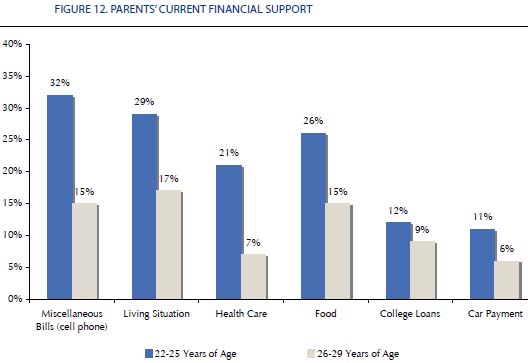
“Unfulfilled Expectations: Recent College Graduates Struggle in a Troubled Economy,” Heldrich Center for Workforce Development, Rutgers University.
Some other findings from the Rutgers study: 60 percent of the graduates of the college classes of 2006 through 2010 said they held a part-time job while enrolled in school, not including jobs held during the summer or between semesters. Another 23 percent said they were working full time or both full and part time during school. For 44 percent of students, work or personal savings helped finance their schooling. "Today’s young people," said Carl Van Horn, a labor economist at Rutgers and co-author of the study, "are very focused on trying to work hard and to get ahead.”

 PenPenWrites
Leave a comment